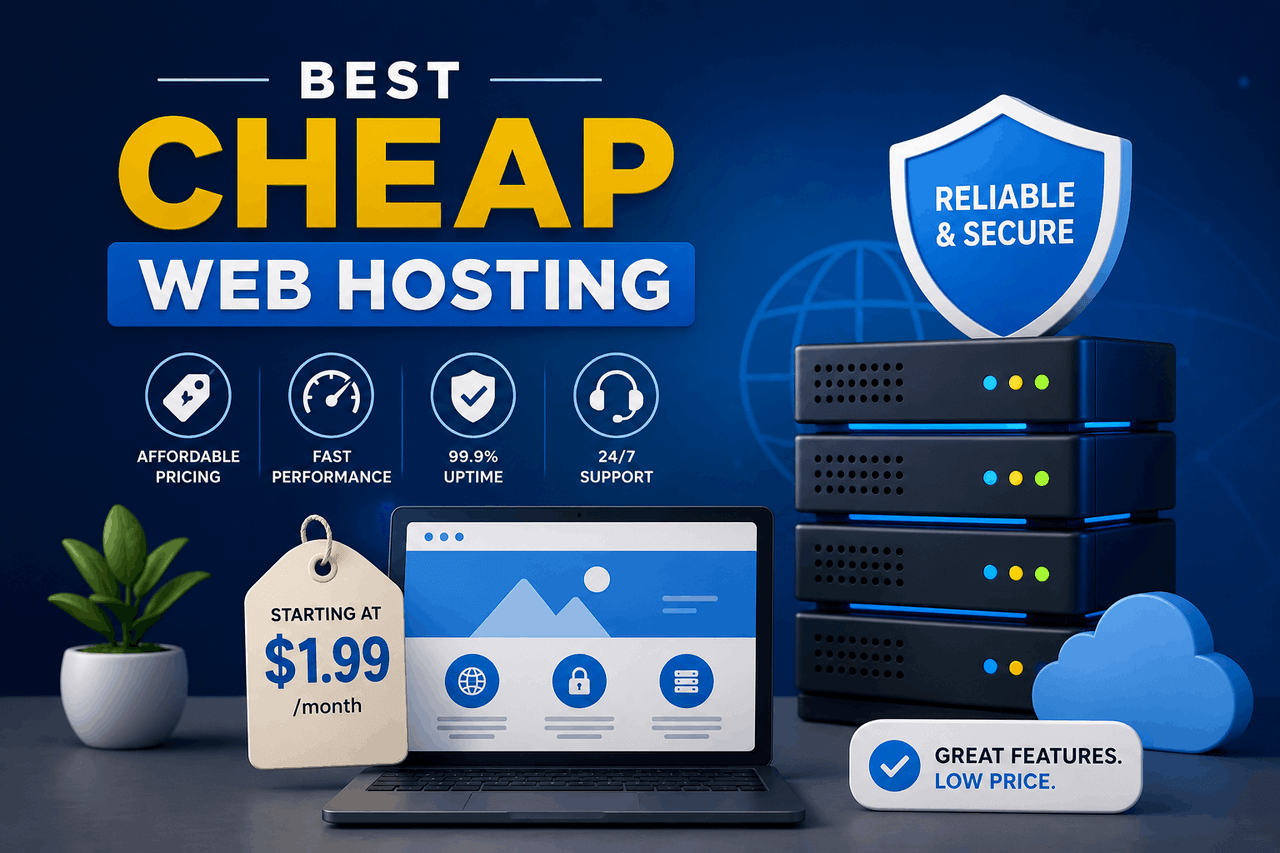
The best cheap web hosting provider depends on your specific needs. Hostinger offers the lowest introductory rates for beginners. DreamHost provides the best value for month-to-month plans without renewal hikes. Choose a shared hosting plan if you are starting a new, low-traffic website to keep costs under $5 per month.
Setting up a website is like renting an apartment. You need a space on the internet to store your digital furniture—your images, text, and code files. A web hosting provider gives you that digital real estate. Without a web hosting provider, your website cannot exist online.
Finding an affordable digital space does not mean you have to settle for a bad neighbourhood. Many leading web hosting providers offer budget-friendly entry plans that deliver excellent speeds and strong security. The challenge lies in separating the genuinely good deals from the plans that mask poor performance behind a low price tag.
You can find the best cheap web hosting without compromising quality if you know exactly what to look for. This guide will walk you through the top budget-friendly web hosting providers, explain the core features you actually need, and show you how to avoid hidden renewal fees that catch many beginners by surprise.
What are the basics of web hosting?
Before you purchase a hosting plan, you need to understand what you are actually buying. Web hosting comes in several tiers, each serving a different type of website owner.
What are the different types of web hosting?
Shared Hosting
Shared hosting is the entry-level option for most new websites. You share a single physical server—and all its resources—with hundreds of other websites. This setup keeps your costs incredibly low, usually between $2 and $5 per month. Shared hosting is excellent for personal blogs, portfolio sites, and small local business pages. Be aware that if another site on your server experiences a massive traffic spike, your website may temporarily slow down.
Virtual Private Server (VPS) Hosting
VPS hosting is the middle ground. You still share a physical server with others, but the web hosting provider sections off a dedicated portion of that server’s resources just for you. This means another website’s traffic spike will not impact your load times. VPS hosting usually costs between $15 and $30 per month. It is a logical next step for growing websites that receive consistent daily traffic but do not yet need a full server.
Cloud Hosting
Cloud hosting distributes your website across a network of interconnected virtual servers. If one server goes down, another instantly takes its place. This structure provides exceptional reliability and handles traffic spikes effortlessly. Cloud hosting generally starts around $20 per month. You will want to consider cloud hosting if you run an online store where even one minute of downtime costs you direct revenue.
Which key hosting features should you look for?
Uptime Guarantees
Uptime is the percentage of time your website is accessible to visitors. You want a web hosting provider that guarantees at least 99.9% uptime. A 99.9% uptime guarantee still allows for about 43 minutes of downtime per month. Anything less than 99.9% means your site could be offline frequently, costing you visitors and search engine rankings.
Bandwidth Allowances
Bandwidth dictates how much data can flow between your website and your visitors. If your site has heavy image files and thousands of visitors, you need more bandwidth. Many cheap web hosting providers advertise “unmetered” bandwidth. Unmetered does not mean infinite. It simply means they do not strictly measure your usage until you consume so much that you impact other users on the server.
Storage Space
Storage is the amount of hard drive space allocated for your website’s files. Most new websites use less than 2 GB of storage. A plan offering 10 GB to 50 GB of Solid State Drive (SSD) storage is more than enough for a standard small business site.
Who are the top 5 affordable web hosting providers?
Finding a cheap web hosting provider is easy. Finding one that keeps your site fast and secure is harder. Here is a breakdown of the top affordable web hosting providers available today.
1. Hostinger
Overview
Hostinger is a highly popular web hosting provider known for aggressive introductory pricing and a custom, beginner-friendly control panel. They consistently offer some of the fastest load times in the budget category.
Who is this for?
Hostinger is ideal for beginners who want to launch a website as cheaply as possible without dealing with complicated technical dashboards.
Risks
The lowest advertised prices require a 48-month upfront commitment. When that initial term ends, the renewal rates increase significantly. They also do not offer phone support.
Rewards
You get access to LiteSpeed web servers, which deliver excellent page loading speeds. The custom hPanel dashboard is much easier to navigate than the traditional cPanel used by most competitors.
2. DreamHost
Overview
DreamHost is one of the oldest web hosting providers and one of only three hosts officially recommended by WordPress.org. They stand out by offering true month-to-month plans without harsh renewal price hikes.
Who is this for?
DreamHost is an excellent choice for website owners who prefer predictable pricing and want to build a WordPress site without committing to a multi-year contract.
Risks
Their starter plan does not include free email accounts. You have to pay extra to get a professional email address tied to your domain name. Their live chat support is also restricted to specific daytime hours.
Rewards
DreamHost offers a generous 97-day money-back guarantee, giving you ample time to test their services. Their pricing remains flat and transparent, so you will not face sudden billing surprises after your first year.
3. Bluehost
Overview
Bluehost is perhaps the most heavily advertised web hosting provider on the internet. Like DreamHost, they carry an official WordPress recommendation. They provide a highly guided setup process for new users.
Who is this for?
Bluehost works best for absolute beginners who need a step-by-step walkthrough to install WordPress and get a basic site online.
Risks
Bluehost’s renewal rates are steep. A plan that costs $2.95 per month initially can jump to $10.99 per month upon renewal. Their basic tier also strictly limits your storage space to 10 GB.
Rewards
You receive a free domain name for your first year. The onboarding process is incredibly smooth, and they offer 24/7 phone support if you encounter technical hurdles.
4. HostGator
Overview
HostGator is a well-known web hosting provider featuring a mascot named Snappy. They provide unmetered bandwidth and unmetered storage on nearly all their shared hosting plans.
Who is this for?
HostGator is a solid fit for users who want to host multiple small websites on a single, budget-friendly account, as their mid-tier plans offer unlimited domains.
Risks
HostGator frequently attempts to add paid extras to your cart during checkout. You must read the checkout page carefully to untick boxes for services you do not want. Their server speeds are average compared to Hostinger.
Rewards
HostGator includes a free domain name for the first year and offers a 45-day money-back guarantee. Their control panel is standard and familiar to anyone who has built websites before.
5. Namecheap
Overview
Namecheap started as a domain registrar but now operates as a full-service web hosting provider. They offer some of the lowest barrier-to-entry prices on the market, along with free domain privacy.
Who is this for?
Namecheap is perfect for highly budget-conscious users who want to host a simple, static website or a small personal blog.
Risks
Their data centres are limited, and server performance can be slightly slower than that of top-tier competitors. The basic plan limits you to 20 GB of storage and 30 email accounts.
Rewards
Namecheap offers an automatic backup tool free of charge, a feature most cheap web hosting providers charge extra for. Their renewal pricing remains very low and fair.
What factors should you consider when choosing cheap web hosting?
Price is only one part of the equation. A web hosting provider is a business partner, and you need to evaluate them on how they protect and serve your digital assets.
How do performance and reliability affect your site?
Website speed directly impacts your bottom line. Visitors tend to leave a website if it takes longer than three seconds to load. You will want to consider web hosting providers that use SSD storage and have servers physically located near your primary target audience. If your readers are in Europe, choosing a host with data centres only in the United States will result in slower load times.
Which security features are non-negotiable?
A cheap plan is a bad deal if it leaves your site vulnerable to attacks. Every web hosting provider you consider must offer a free SSL certificate. An SSL certificate encrypts data passing through your site and displays a padlock icon in the browser address bar. You also need routine automatic backups. If your site breaks or gets hacked, a recent backup lets you restore it with a single click.
Why does customer support matter for cheap hosting?
Technology fails occasionally. When your website goes offline, you need answers immediately. You should look for a web hosting provider that offers 24/7 live chat support as a baseline. Test their support response times before you buy by asking a pre-sales question. If they take 30 minutes to answer a sales query, they will likely take even longer to address a technical emergency.
What are scalability options?
Your website will hopefully grow. As your daily visitor count increases, your shared hosting plan will eventually struggle to keep up. A good web hosting provider offers a clear upgrade path. You want the ability to move seamlessly from a shared hosting plan to a VPS or cloud hosting plan without having to migrate your site to a completely different company.
How do hidden costs and renewal rates work?
The biggest complaint in the web hosting industry involves renewal rates. Providers advertise a $2.95 monthly price, but it applies only if you pay 36 months in advance. When that term ends, the price often jumps to $10 or $12 per month. You must read the fine print to find the regular renewal rate. Also, be aware that features like professional email, automated backups, and advanced security scans are often sold as separate add-ons.
How can you improve your cheap web hosting plan?
Buying a cheap web hosting plan means you are working with limited server resources. You have to keep your website lean to ensure it runs quickly on a shared server.
Improving Website Performance
You can significantly improve your site speed by compressing your images before uploading them. Large image files force the server to work harder, slowing page loads. You should also install a caching plugin if you use WordPress. Caching saves a static version of your site, meaning the server does not have to load heavy background scripts every time a new visitor arrives.
Utilising Free Tools and Integrations
You do not need to buy expensive add-ons from your web hosting provider to run a secure site. You can route your domain through a free Content Delivery Network (CDN), such as Cloudflare. A CDN stores copies of your site on servers around the world, making it load faster for international visitors. It also provides a free layer of security against malicious bots and attacks.
Ready to launch your new website?
Finding the best cheap web hosting provider requires looking past the flashy advertising and understanding the long-term costs. A provider like Hostinger offers the best initial speeds for your dollar, while DreamHost offers the fairest long-term pricing model.
You do not need to spend a fortune to build a reliable online presence. Start with a basic shared hosting plan, keep your website files clean and compressed, and rely on free third-party tools to handle security and caching. By choosing a web hosting provider with a solid uptime guarantee and responsive customer support, you set a strong foundation for your digital real estate.
FAQs about Cheap Web Hosting
How much should cheap web hosting cost?
A reliable, cheap web hosting provider typically charges between $2 and $5 per month for an introductory shared hosting plan. You should expect this price to increase to between $7 and $12 per month when your initial contract term renews.
Can I run an online store on cheap web hosting?
You can run a very small online store on a cheap shared hosting plan, but it is not ideal for high-traffic commerce. If your store grows and processes multiple transactions simultaneously, you will likely need to upgrade to VPS hosting to maintain secure, fast checkouts.
What is the difference between web hosting and a domain name?
A domain name is your website’s address (like yoursite.com), while web hosting is the physical server space where your website’s files live. You need both to run a website, though many cheap web hosting providers include a free domain name for your first year.
Are free web hosting providers a good alternative?
Free web hosting is generally a poor alternative for professional sites. Free hosts often force banner ads on your website, offer extremely limited storage, and provide no reliable uptime guarantees. You are much better off paying $3 a month for a cheap web hosting provider to maintain control of your brand.
How long does it take to set up cheap web hosting?
Setting up an account with a cheap web hosting provider usually takes less than ten minutes. Once you pay for the plan, most hosts provide a one-click installation tool that instantly installs a platform like WordPress on your new server space.