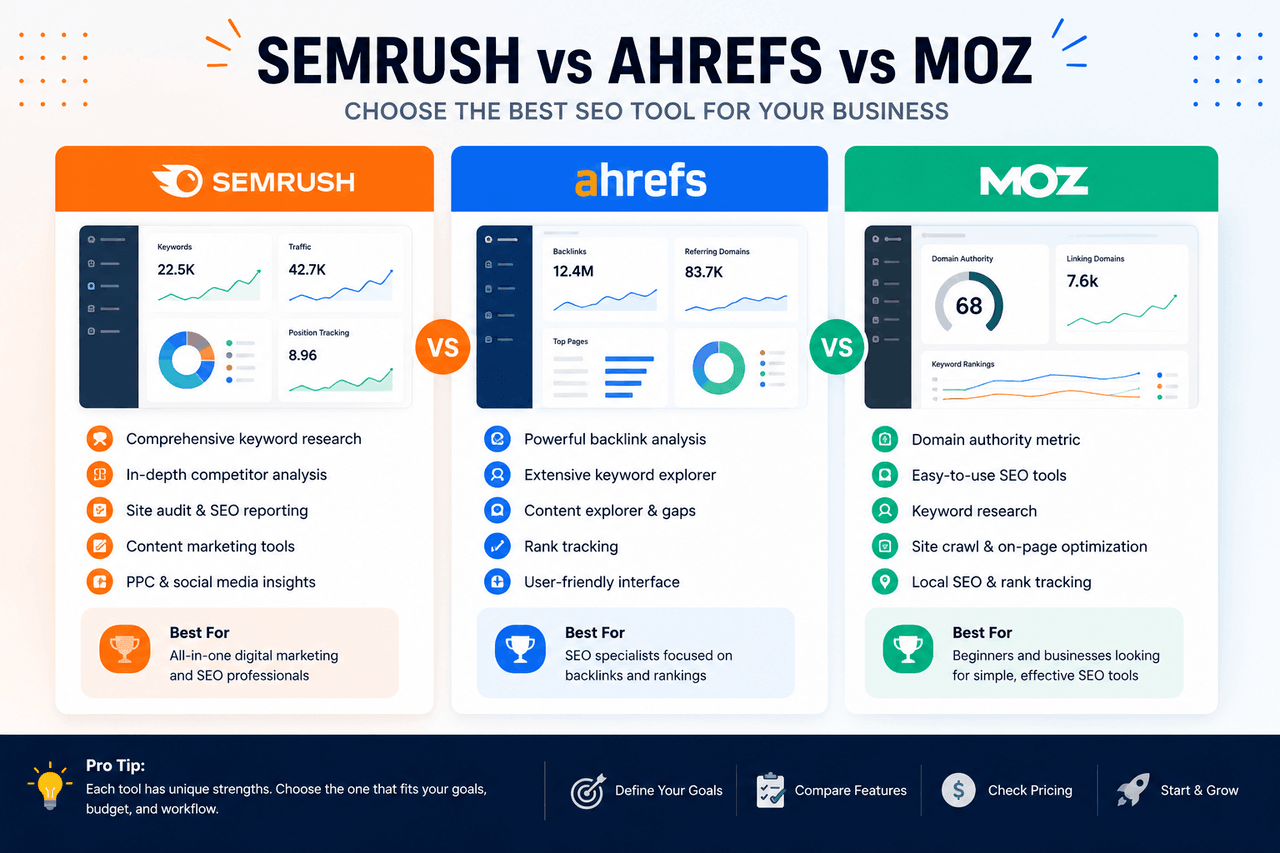
SEMrush, Ahrefs, and Moz are three of the most popular SEO tools, and the best one depends on your needs. SEMrush suits agencies and PPC-focused teams wanting an all-in-one platform. Ahrefs is the top pick for backlink analysis and content research. Moz is best for beginners who value ease of use and learning resources.
Choosing an SEO tool is one of the bigger decisions you’ll make as a marketer or business owner. The right platform helps you find keywords, track rankings, fix technical issues, and spy on competitors. The wrong one drains your budget and gathers dust.
SEMrush, Ahrefs, and Moz dominate the conversation for good reason. Each one packs a deep feature set, a large database, and a loyal following. But they’re not interchangeable. They differ in price, focus, and how steep the learning curve gets.
This post breaks down what each tool does well, where it falls short, and who it’s built for. By the end, you’ll know which platform fits your goals and your budget—so you can stop comparing tabs and start optimizing.
What is SEMrush and what does it do?
SEMrush is an all-in-one digital marketing platform built for SEO, PPC, content, and competitive research. That means you can run most of your marketing work from a single dashboard instead of juggling separate tools.
Key features:
- Keyword research with search volume, difficulty, and intent data
- Site audit that flags technical SEO issues across your site
- Backlink analysis to track your link profile and competitors’ links
- Competitor analysis to uncover the keywords and strategies rivals use
- Advertising research for planning and refining PPC campaigns
Strengths: SEMrush shines as a complete toolkit. Few platforms cover this much ground. Its PPC and advertising features are some of the strongest available, which makes it a favorite for teams running both paid and organic campaigns. The interface is clean and well-organized, so most users find their footing quickly.
Weaknesses: That said, all this power comes at a price. SEMrush sits at the higher end of the market, which can sting for solo users and small teams. Data accuracy can also dip for smaller or more specialized niches, where search volume estimates may be thinner.
What is Ahrefs, and what does it do?
Ahrefs started life as a backlink tool and grew into a full SEO suite. So if links and content are your priority, Ahrefs has deep roots in exactly those areas.
Key features:
- Backlink analysis powered by one of the largest link databases available
- Keywords Explorer with detailed metrics across multiple search engines
- Site Explorer to analyze any domain’s traffic and links
- Content Explorer to find top-performing content in any niche
- Rank Tracker to monitor your keyword positions over time
Strengths: Ahrefs is widely regarded as best-in-class for backlink data. Its crawler is fast, and its index is huge, so you get a clear picture of who links to whom. Content Explorer is another standout—it helps you spot proven topics and link opportunities you’d otherwise miss.
Weaknesses: The interface can feel overwhelming at first, especially if you’re new to SEO. There’s a lot packed into each screen. Ahrefs also offers weaker PPC features than SEMrush, so it’s less suited to teams that lean heavily on paid search.
What is Moz, and what does it do?
Moz is an SEO platform known for its approachable design and strong educational community. That means newcomers can learn the ropes without feeling lost.
Key features:
- Keyword Explorer for finding and prioritizing keywords
- Link Explorer for backlink research
- Site Crawl to surface technical issues
- Rank Tracking to follow your positions
- MozBar, a browser extension that shows SEO metrics as you browse
Strengths: Moz popularized Domain Authority, a score that predicts how well a site might rank. Many marketers still use it as a quick benchmark. Moz also offers some of the best learning resources in the industry, from beginner guides to its long-running community. The interface is clean and friendly for first-timers.
Weaknesses: Moz’s databases for keywords and backlinks are smaller than those of SEMrush and Ahrefs. For experienced users who want the deepest data and the most advanced features, Moz can feel limited.
How do SEMrush, Ahrefs, and Moz compare feature by feature?
Each tool covers the core SEO tasks, but they don’t all do them equally well. Here’s how they stack up.
Keyword research
All three offer solid keyword tools. SEMrush gives you the broadest mix of keywords, intent, and PPC data in one place. Ahrefs provides rich metrics and pulls data across several search engines, which is handy if you target more than Google. Moz keeps things simple and beginner-friendly, though its keyword database is the smallest of the three.
Backlink analysis
This is where the gap shows. Ahrefs leads on backlink data thanks to its large, frequently updated index. SEMrush has closed much of the distance and offers strong link analysis of its own. Moz’s Link Explorer works well but draws from a smaller database, so you may miss some links that the others catch.
Site auditing
SEMrush offers a thorough site audit that flags a wide range of technical issues with clear, prioritized fixes. Ahrefs’ Site Audit is fast and visual, making problems easy to spot. Moz’s Site Crawl covers the essentials and explains issues in plain language—useful if you’re still learning.
Competitor analysis
SEMrush is the standout here. Its competitive research spans organic, paid, and even ad copy, so you can see exactly how rivals compete. Ahrefs excels at competitor backlink and content gaps, helping you find where to focus. Moz offers competitor insights, too, but with less depth.
Unique features
Each tool has something the others don’t. SEMrush has its advertising and PPC toolkit. Ahrefs has Content Explorer for content research at scale. Moz has Domain Authority and MozBar, the browser extension that many marketers check reflexively.
How much do SEMrush, Ahrefs, and Moz cost?
Pricing matters, especially when these tools become a monthly fixed cost. All three use tiered plans that scale with features, projects, and data limits.
Generally speaking, SEMrush and Ahrefs sit at a similar price point, with entry plans typically running over $100 per month and higher tiers climbing well beyond that. Moz tends to start at a slightly lower entry price, which adds to its appeal for beginners and small businesses.
Here’s how to think about value at each level:
- Individuals and freelancers: Moz often delivers the best value if you want core SEO features without the steepest cost. Ahrefs is worth it if backlinks are central to your work.
- Small businesses: Any of the three can work. Match the plan to your priorities—PPC and all-in-one with SEMrush, links and content with Ahrefs, simplicity with Moz.
- Agencies and enterprises: SEMrush usually wins here, since its breadth covers multiple clients and channels from one platform.
Prices change over time, so check each provider’s current plans before you commit.
Which tool is easiest to use and best supported?
Ease of use varies a lot between these platforms. Moz is the friendliest for beginners, with a clean layout and gentle learning curve. Its guides, courses, and community make it easy to build skills as you go.
SEMrush balances depth with usability. There’s a lot to learn, but the interface is organized, and the help resources are solid. Ahrefs is powerful but can overwhelm newcomers—expect to spend time getting comfortable before it clicks.
On support, all three offer help docs, tutorials, and customer service. Moz stands out for its educational content. Ahrefs and SEMrush both run popular blogs, webinars, and active user communities.
Pros and cons summary
Tool | Pros | Cons |
|---|---|---|
SEMrush | All-in-one toolkit, strong PPC features, user-friendly interface | Higher cost, weaker data for small niches |
Ahrefs | Best-in-class backlink data, excellent content analysis | Steeper learning curve, weaker PPC tools |
Moz | Domain Authority, great learning resources, beginner-friendly | Smaller database, fewer advanced features |
Who is each SEO tool best for?
The right choice comes down to who you are and what you need most.
Choose SEMrush if you run an agency, focus heavily on PPC, or want one platform that handles SEO, paid search, and content together. It’s the most complete option for teams managing many channels or clients.
Choose Ahrefs if you’re an SEO specialist or content marketer who lives in backlink and content data. When link building and competitor research drive your strategy, Ahrefs gives you the deepest well to draw from.
Choose Moz if you’re new to SEO, run a small business, or value strong educational resources and a supportive community. Moz lowers the barrier to entry without leaving you short on essentials.
Final thoughts: there’s no single best SEO tool
The honest answer to “which is best” is that it depends on your needs. SEMrush, Ahrefs, and Moz are all excellent—they just excel in different areas. SEMrush wins on breadth and PPC, Ahrefs on backlinks and content, and Moz on accessibility and learning.
The smartest next step? Try before you buy. Each tool offers a trial or limited free features, so you can test the interface and data against your own site and goals. Spend a few days in each, see which one fits how you work, and let that guide your decision. Your SEO strategy is unique. Your tool should match it.
FAQs on SEMrush vs Ahrefs vs Moz
Is Moz better than SEMrush?
Moz isn’t necessarily better than SEMrush—it’s better for certain users. Moz is easier for beginners and offers excellent learning resources, while SEMrush provides a broader toolkit and deeper data. If you’re new to SEO or run a small business, Moz may suit you better. If you need an all-in-one platform with strong PPC features, SEMrush is the stronger pick.
Is SEMrush better than Ahrefs?
It depends on your focus. SEMrush is better for all-in-one marketing and PPC, since it covers SEO, paid search, and advertising research in one place. Ahrefs is better for backlink analysis and content research, where it’s widely seen as best-in-class. Many SEO professionals use Ahrefs for links and SEMrush for broader campaigns.
Which SEO tool is best?
There’s no single best SEO tool—the right choice depends on your goals, budget, and experience. SEMrush is best for agencies and PPC-focused teams. Ahrefs is best for backlink and content analysis. Moz is best for beginners and small businesses that value ease of use. Trying free trials of each is the surest way to decide.
What is Moz, and what is Ahrefs?
Moz and Ahrefs are both SEO software platforms. Moz is known for its Domain Authority metric, beginner-friendly design, and strong educational community. Ahrefs is known for its large backlink database and content research tools. Both help you with keyword research, rank tracking, site audits, and link analysis, but they differ in focus and depth.