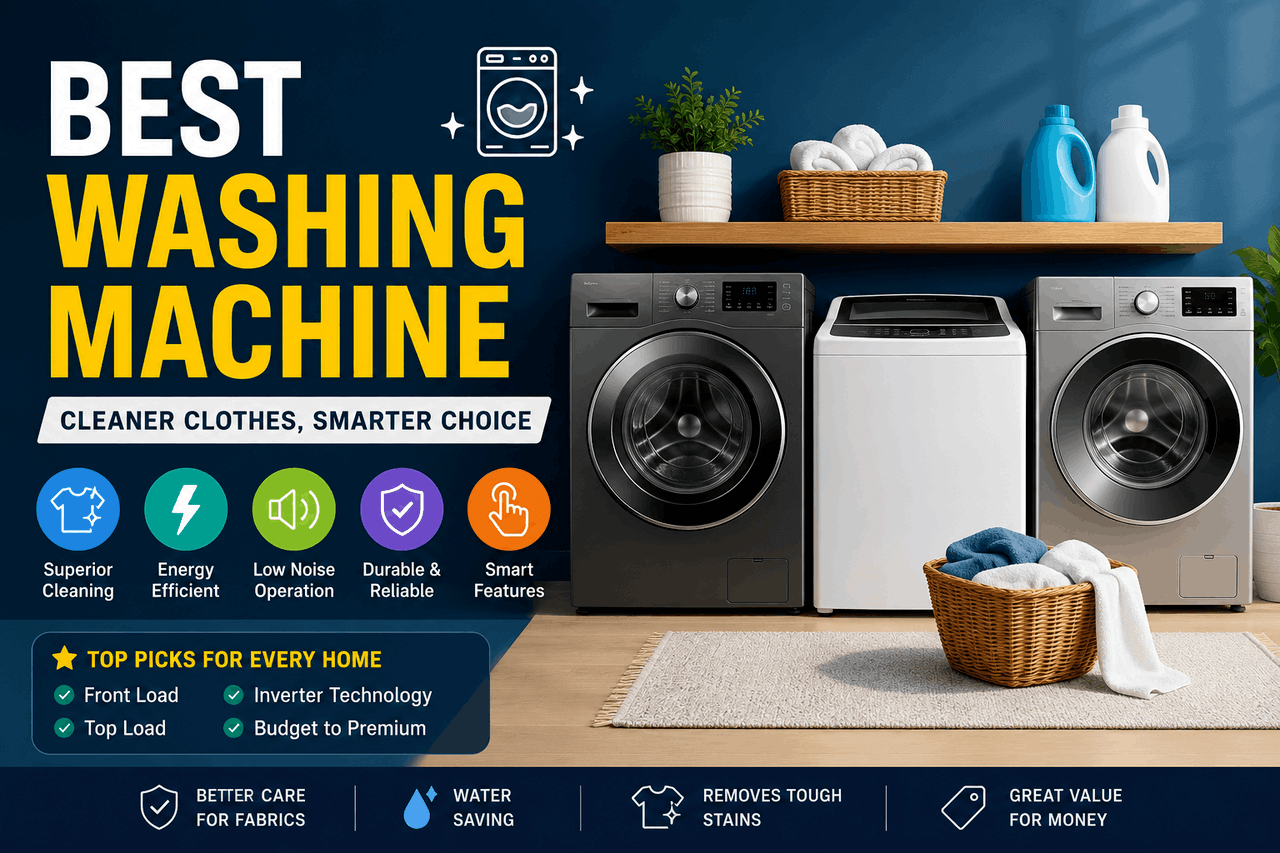
The best washing machine depends on your space, budget, and family size. Front-loading machines like the LG WM4000HWA offer the best cleaning performance and energy efficiency. Top-loading machines like the GE GTW465ASNWW are better for buyers on a strict budget who want faster wash cycles and a traditional design.
A washing machine is the workhorse of your home. It handles grass-stained jeans, delicate sweaters, and heavy winter bedding week after week. When a washing machine works well, you barely notice it. When it fails, laundry piles up quickly, disrupting your entire routine.
Washing machines have evolved significantly since the early electric models of the 1900s. Early machines required manual wringing and constant supervision. Today, modern washing machines feature built-in water heaters, smart sensors, and automated cycles that do the heavy lifting for you.
Finding the right machine means balancing your budget against the features you actually need. You will want to look at capacity, energy efficiency, and cleaning performance. The right choice will save you money on water and electricity bills while keeping your clothes looking new for years.
What are the different types of washing machines?
Before you look at specific models, you need to understand the main categories. Washing machines generally fall into four distinct types.
Front-loading washing machines
Front-loading machines are the high-performance vehicles of the laundry world. They use a horizontal drum that tumbles clothes through a small pool of water. This tumbling action cleans clothes more thoroughly and uses significantly less water than other designs. Front-loaders also spin much faster, removing more water from your clothes and reducing the time spent in the dryer. Be aware that they require bending down to load and unload, and the rubber door seal needs regular wiping to prevent mould.
Top-loading washing machines
Top-loaders are the traditional choice. You load clothes from the top, which is easier on your back. They come in two variations: agitator and impeller. Agitator models use a central post to rub clothes together, which is tough on stains but can wear out fabrics faster. Impeller models use a low-profile cone at the bottom to move clothes around, offering a gentler wash and more drum space. Top-loaders usually cost less upfront but consume more water and energy over time.
Fully automatic washing machines
Fully automatic machines do everything at the push of a button. You load the clothes, add detergent, and select a cycle. The machine handles the washing, rinsing, and spinning without any further intervention. These machines connect to a continuous water supply. Both front-loaders and modern top-loaders fall into this category.
Semi-automatic washing machines
Semi-automatic machines require manual effort. They usually feature two separate tubs: one for washing and one for spinning. You must manually move the wet clothes from the wash tub to the spin tub. These machines are labour-intensive. However, they use less water, do not require a continuous water connection, and are the most budget-friendly option available.
What factors should you consider before buying?
Buying a washing machine requires more than just picking a reputable brand. You need to match the machine’s specifications to your daily life.
Capacity and drum size
Capacity dictates how much laundry you can wash at once. It is measured in cubic feet. A machine with a 4.5-cubic-foot capacity is sufficient for a family of four. If you live alone or with a partner, a smaller 2.5-cubic-foot machine works well. Large families of six or more should look for capacities of 5.0 cubic feet or higher to handle bulky items like king-size comforters.
Wash programs and cycles
Basic machines offer normal, delicate, and heavy-duty cycles. Advanced machines offer specialised programs. If you have a busy schedule, a quick wash cycle can clean a small load in 15 to 20 minutes. If you have sensitive skin, an allergen cycle uses steam to remove dust mites and pet dander.
Energy efficiency
A cheap machine can cost you more in utility bills over its lifespan. Look for the Energy Star label. According to the EPA [Energy Star, 2023], certified washing machines use about 20% less energy and 30% less water than standard models. High-efficiency machines usually cost more upfront but pay for themselves through lower monthly utility bills.
Spin speed
Spin speed is measured in revolutions per minute (RPM). Faster spin speeds extract more water from your clothes. Front-loaders often reach 1,300 RPM, while top-loaders typically max out around 800 RPM. Clothes that come out of the dryer take less time to dry, which saves additional energy.
Advanced features
Modern machines offer features that make laundry easier. In-built heaters regulate water temperature precisely to remove tough stains. Inverter technology reduces motor friction, making the machine quieter and more durable. Smart features allow you to start a load from your phone or receive an alert when a cycle finishes.
Brand reputation and budget
Stick to brands with a proven track record for reliability and strong after-sales service. A basic top-loader might cost $400, while a high-end smart front-loader can exceed $1,500. Set a budget before you shop, and focus on the features that provide the most value for your specific needs.
What are the best washing machines?
We categorised the best washing machines based on specific needs and living situations.
- Best overall: LG WM4000HWA Front-Load Washer
- Best budget-friendly: GE GTW465ASNWW Top-Load Washer
- Best for large families: Samsung WV60M9900AV FlexWash
- Best for small apartments: Bosch 300 Series WAT28400UC
- Best with advanced features: Electrolux ELFW7637AT
- Best semi-automatic: Giantex Portable Mini Twin Tub
In-depth reviews of our top washing machine picks
Here is a closer look at why these specific models stand out from the competition.
LG WM4000HWA Front-Load Washer (Best overall)
The LG WM4000HWA is an excellent choice for a household that wants a reliable, high-performing machine without an astronomical price tag.
- Key features: 4.5 cubic feet capacity, built-in intelligence that selects optimal wash motions, steam cleaning, and a 1,300 RPM spin speed.
- Pros: It cleans exceptionally well, runs quietly, and features a door that stays slightly ajar to prevent mildew.
- Cons: The control panel lacks backlighting, making it hard to read in dimly lit laundry rooms.
- User summary: Buyers consistently praise this model for its speed. The TurboWash feature cleans a normal load in under 30 minutes, which is a massive time-saver for busy families.
GE GTW465ASNWW Top-Load Washer (Best budget-friendly)
This GE model is an excellent choice for an investor who wants a traditional, straightforward washing machine without spending more than $600.
- Key features: 4.5 cubic feet capacity, dual-action agitator, deep fill option, and 700 RPM spin speed.
- Pros: It is highly affordable, easy to operate, and handles heavy dirt well thanks to the agitator.
- Cons: It uses more water than a front-loader and can be rougher on delicate fabrics.
- User summary: Owners appreciate the simple dial controls and the deep-fill option, which allows them to add more water to heavily soiled loads like work clothes.
Samsung WV60M9900AV FlexWash (Best for large families)
The Samsung FlexWash offers two distinct washing drums in one unit. It is perfect for large families that need to wash separate loads simultaneously.
- Key features: Total 6.0 cubic feet capacity (5.0 lower drum, 1.0 upper drum), Wi-Fi connectivity, and super speed cycle.
- Pros: You can wash a heavy load of towels on the bottom and delicate lingerie on the top at the same time.
- Cons: It is very expensive and takes up more vertical space than a standard washer.
- User summary: Large households love the dual-wash capability, noting it cuts their laundry time in half on weekends.
Bosch 300 Series WAT28400UC (Best for small apartments)
This Bosch compact washer is designed for small spaces. It fits in tight closets or under standard kitchen counters.
- Key features: 2.2 cubic feet capacity, 1,400 RPM spin speed, and a very quiet motor.
- Pros: It fits almost anywhere, operates in near silence, and extracts water incredibly well.
- Cons: The small capacity means you will need to do laundry more frequently.
- User summary: Apartment dwellers rate this highly for its compact footprint and quiet operation, allowing them to run loads at night without disturbing neighbours.
Electrolux ELFW7637AT (Best with advanced features)
The Electrolux ELFW7637AT is for the buyer who wants premium stain-removal and fabric-care technology.
- Key features: 4.5 cubic feet capacity, SmartBoost technology (pre-mixes water and detergent), and an optic whites cycle.
- Pros: It offers arguably the best stain-removal performance on the market and has a dedicated pod dispenser.
- Cons: Cycle times are generally longer than competitors’.
- User summary: Users highly rate its ability to remove tough, set-in stains like chocolate and wine without requiring manual pre-treatment.
Giantex Portable Mini Twin Tub (Best semi-automatic)
This Giantex model is an excellent choice for an individual living in an RV, a dorm, or an apartment without traditional washer hookups.
- Key features: 11 lbs wash capacity, 6.6 lbs spin capacity, and lightweight plastic construction.
- Pros: It is highly portable, very cheap, and plugs into a standard 110V outlet.
- Cons: You have to transfer wet clothes to the spin side manually, and it cannot wash large blankets.
- User summary: RV owners and students find this a perfect workaround to avoid communal laundromats, despite the manual labour involved.
How do you maintain a washing machine for longevity?
A washing machine usually lasts between 10 and 13 years. You can extend its life and prevent bad odours by following a few simple maintenance routines.
First, clean the drum and detergent dispenser regularly. Wipe down the rubber door gasket on front-loaders after every use to prevent mould growth. Leave the door open slightly to let moisture escape. Once a month, remove the detergent drawer and wash it with warm, soapy water to remove thick detergent residue.
Second, avoid overloading the machine. Stuffing too many clothes into the drum puts immense strain on the motor, belts, and bearings. If you have to push clothes down to fit more in, the machine is too full. Clothes need room to move around to get clean.
Third, descale the machine every few months. If you live in an area with hard water, mineral deposits will build up on the heating element and inner pipes. Run an empty hot-water cycle with 2 cups of white vinegar or a commercial descaling tablet to break down these minerals.
How do you troubleshoot common washing machine problems?
Even the best washing machines occasionally run into trouble. You can fix many common issues yourself without calling a repair technician.
Machine not starting
If the machine is completely dead, check the power supply first. Ensure the unit is plugged in and the circuit breaker has not tripped. If the machine turns on but will not start a cycle, check the door latch. Modern washers will not operate if the door is not securely locked.
Excessive noise or vibration
If your machine sounds like an aeroplane taking off, it is likely out of balance. Ensure the washing machine is perfectly level on the floor. Use a bubble level and adjust the machine’s feet as necessary. Inside the drum, a heavy item, such as a single wet towel, can throw the machine off balance. Pause the cycle and redistribute the weight evenly.
Water leakage
Water on the floor is stressful. Check the fill hoses connected to the back of the machine. The rubber washers inside these hoses wear out over time and should be replaced every five years. If water leaks from the front door of a front-loader, the rubber gasket is likely damaged or has hair and lint trapped under it.
Clothes are not being cleaned properly
If your clothes come out dirty or covered in soap residue, you might be using too much detergent. High-efficiency machines require very little soap. Using too much creates excess suds that trap dirt and redeposit it onto your clothes. Switch to a high-efficiency (HE) detergent and follow the exact measurements on the bottle.
Your next steps for finding the perfect washer
Choosing a washing machine is a long-term commitment. You will want to honestly evaluate your laundry habits. If you live in a small space, prioritise compact dimensions and quiet operation. If you have a large family, prioritise high capacity and speed.
By paying attention to factors such as energy efficiency, spin speed, and drum size, you ensure you buy a machine that serves your household well. Front-loaders remain the top choice for cleaning performance, but a solid top-loader is a reliable alternative for a tighter budget.
Take a moment to measure your laundry space. Write down the dimensions, check your budget, and select a model that aligns with your daily routine.
FAQs about washing machines
How much does a good washing machine cost?
A reliable top-loading washing machine usually costs between $500 and $700. High-efficiency front-loading machines typically cost between $800 and $1,200. Models with smart features or dual-wash capabilities can exceed $1,500.
How long should a washing machine last?
A washing machine typically lasts between 10 and 13 years [Consumer Reports, 2023]. You can extend this lifespan by regularly cleaning the drum, avoiding overloading, and replacing worn hoses every five years.
What is the difference between an agitator and an impeller?
An agitator is a tall post in the centre of a top-loading washer that rubs against clothes to remove dirt. An impeller is a low-profile cone or disc that spins to move clothes against each other. Impellers are gentler on fabrics and provide more room in the drum, while agitators offer heavy-duty cleaning for tough stains.
Do I really need a smart washing machine?
Choose a smart washing machine if you want the convenience of starting cycles remotely or receiving smartphone alerts when your laundry is done. If you prefer a simple, set-and-forget appliance, a standard washing machine will serve you perfectly well at a lower price.