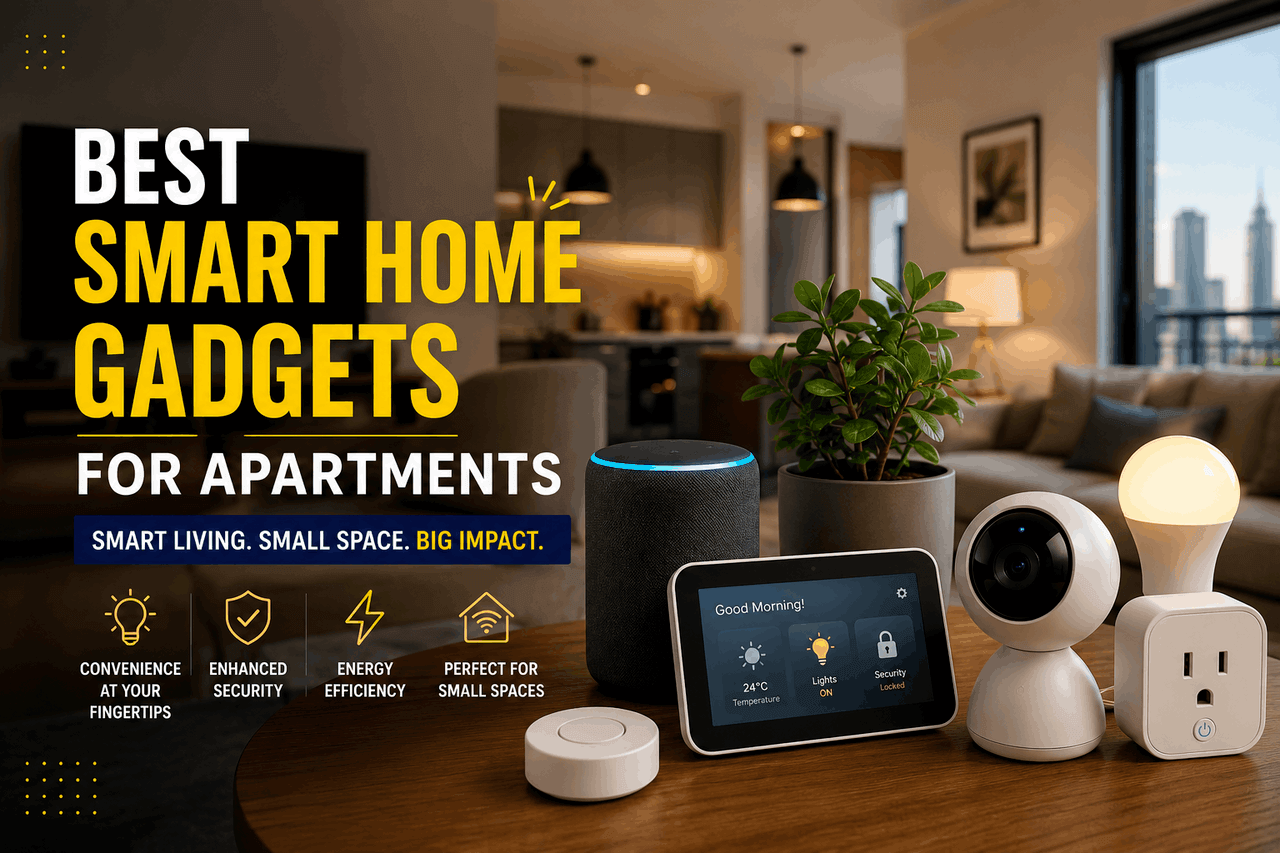
The best smart home gadgets for apartments offer security and convenience without requiring permanent installation or wiring changes. Top choices include Philips Hue smart bulbs for custom lighting, the August Smart Lock for keyless entry over your existing deadbolt, and TP-Link Kasa smart plugs for controlling standard appliances.
Setting up a smart home in an apartment is like planting a garden in pots. You want all the benefits of the beautification, but you need the ability to pick it up and move when the lease ends. Renters often assume smart home technology requires separation into drywall or rewiring electrical panels. That is no longer true. Today’s smart home gadgets install in minutes and leave no trace behind when you pack up your moving boxes.
Building a smart apartment allows you to automate daily routines, monitor your front door from your desk, and lower your monthly utility bills. You do not need to own a property to experience the convenience of voice-controlled lighting or automatic locks. You just need to choose devices specifically designed for temporary living spaces.
Smart home brands now cater directly to renters. They build products that rely on strong adhesive strips instead of heavy screws. They design locks that fit over existing hardware, so your landlord’s master key continues to function. By selecting the right combination of connected devices, you can modernize your rental unit while keeping your security deposit entirely safe.
What are the best smart lighting solutions for apartments?
Lighting changes the entire feel of a small apartment. Upgrading your rental’s standard fixtures with smart lighting is the easiest way to make a generic space feel yours distinctly.
How do smart bulbs improve apartment lighting?
Smart bulbs replace standard light bulbs in your existing lamps and ceiling fixtures. They connect to your apartment’s Wi-Fi network, allowing you to control brightness, set schedules, and change colors directly from an app on your phone. Brands like Philips Hue and LIFX dominate this category with high-quality color rendering and reliable connections.
Who is this for?: You want to change the mood of a room without installing complicated dimmer switches. You prefer waking up to a gradual brightening of light rather than a harsh alarm clock.
Risks: Smart bulbs cost significantly more than standard LED bulbs, usually running between $15 and $50 per bulb, depending on the color features. They also require the physical wall switch to remain in the “on” position to function. If a roommate flips the switch off, the bulb loses power and drops its connection to your phone.
Rewards: You gain the ability to set automated schedules, shift the color temperature from cool white to warm amber, and turn off every light in the apartment from your bed. When you move to a new apartment, you simply unscrew the bulbs and take them with you.
Where should you use smart light strips?
Smart light strips are flexible ribbons of LED lights with a sticky adhesive backing. You cut them to your desired length and attach them to the undersides of furniture, the backs of televisions, or along the top edges of kitchen cabinets.
Who is this for?: You want to add depth and visual interest to your apartment. You enjoy hosting movie nights and want bias lighting behind your television to reduce eye strain in a dark room.
Risks: The adhesive backing can occasionally peel low-quality paint when removed. You need to apply heat with a hair dryer to soften the glue before taking them down at the end of your lease. Furthermore, light strips require proximity to a wall outlet for power, which can lead to visible cables if you do not route them carefully.
Rewards: You add high-end, architectural-style lighting to standard apartment cabinetry without drilling a single hole. You can create specific scenes for cooking, watching movies, or reading.
Which smart security devices are renter-friendly?
Apartment security presents a unique challenge. You want to protect your belongings, but you cannot alter the exterior doors or wire camera systems into the building’s electrical grid.
How do smart locks work without replacing the deadbolt?
Renter-friendly smart locks, such as the August Smart Lock or the Yale Assure Lock, attach only to the inside of your apartment door. They physically grip the interior thumb-turn of your existing deadbolt and turn it mechanically. The exterior keyhole remains completely unchanged.
Who is this for?: You want to stop carrying physical keys. You frequently hire dog walkers, cleaners, or sitters and want to grant them temporary access to your apartment without handing over a spare key.
Risks: These locks add bulk to the inside of your door. They run on AA or CR123 batteries, which you will need to replace every three to six months. If the battery dies completely, you will have to use your physical key to enter.
Rewards: You get keyless entry, auto-locking features, and a digital access log that shows exactly when your door opens and closes. Because the exterior lock remains untouched, you never violate your lease agreement. Your landlord’s physical key still works perfectly in an emergency.
Can apartment renters use video doorbells?
Video doorbells feature built-in cameras and two-way audio. While homeowners hardwire these devices, renters can use battery-powered options from companies like Ring or Arlo. Some models even slide directly over the door or replace the standard peephole.
Who is this for?: You receive frequent package deliveries and want to deter porch pirates. You want to see who is knocking before you approach the door.
Risks: Many apartment buildings have strict rules against recording common hallways or shared spaces. You must check your lease agreement and local privacy laws before installing an exterior camera. You also have to detach the unit periodically to recharge its internal battery.
Rewards: You receive instant alerts on your phone when someone approaches your door. You can speak directly to delivery drivers and instruct them to leave packages in a specific location, even when you are sitting in an office miles away.
What are the privacy features of indoor security cameras?
Indoor security cameras plug into a standard wall outlet and sit on a bookshelf or kitchen counter. Options like the Wyze Cam or Blink Mini connect to your Wi-Fi and record motion events directly to the cloud or a local memory card.
Who is this for?: You want to keep an eye on a new puppy while you are at work. You travel frequently and want to monitor your apartment for peace of mind.
Risks: Having an internet-connected camera inside your private living space introduces obvious privacy vulnerabilities. If the device’s manufacturer suffers a data breach, your interior footage could be exposed.
Rewards: You gain a reliable video feed of your apartment for a very low upfront cost. To mitigate privacy concerns, many users plug these cameras into a smart plug that automatically cuts the physical power to the camera when their smartphone connects to the home Wi-Fi network.
How can smart climate control save money in apartments?
Heating and cooling usually represent the largest part of an apartment’s utility bill. Smart devices help you manage that energy consumption more efficiently.
Are smart thermostats compatible with apartment HVAC systems?
Smart thermostats learn your daily routines and automatically adjust the temperature to reduce energy usage when your apartment is empty. Google Nest and Ecobee offer popular models that replace standard wall thermostats.
Who is this for?: You have individual control over your apartment’s central heating and cooling system. You have permission from your landlord to swap the thermostat faceplate, and you want to reduce your monthly electric bills.
Risks: Installation requires handling low-voltage wires. Not all apartment heating systems are compatible with modern smart thermostats. Older buildings with central boiler systems, radiators, or high-voltage baseboard heaters often require specialized equipment. Always take a photo of your existing wiring before disconnecting anything.
Rewards: You can lower your utility bills by adjusting the temperature automatically when the apartment is empty. You can also turn on the air conditioning from your phone while riding the subway home, ensuring you walk into a comfortable space.
How do smart plugs make standard appliances smarter?
A smart plug inserts directly into a standard wall outlet. You then plug your lamp, fan, or coffee maker into the smart plug. This grants the “dumb” appliance instant Wi-Fi connectivity. TP-Link Kasa and Wemo manufacture highly reliable options.
Who is this for?: You want to automate basic electronics without spending money to replace them. You want to ensure your curling iron or space heater is actually turned off after you leave for work.
Risks: Smart plugs are bulky. Depending on their shape, they can block the second socket on a standard wall outlet, reducing the total number of items you can plug in.
Rewards: You turn a cheap floor lamp into a smart device for about $15. You can set timers for your window air conditioning unit or start your morning coffee from your bed.
What smart hubs tie an apartment together?
A collection of smart devices works best when everything communicates through a central hub. This allows you to control different brands from a single interface.
Which smart speaker is best for small spaces?
Smart speakers serve as the central hub for all your other smart home devices. Devices like the Amazon Echo Dot, Google Nest Mini, or Apple HomePod Mini listen for your voice commands and route them to your lights, locks, and plugs.
Who is this for?: You want to control your lights, locks, and plugs using voice commands instead of constantly opening apps on your phone. You want a hands-free way to set cooking timers or check the morning weather.
Risks: You invite a constantly listening microphone into your home. You have to trust the manufacturer’s privacy policies regarding how they store and process your voice recordings.
Rewards: You gain hands-free control over your entire apartment. You can walk through the front door with your hands full of groceries and simply say, “Turn on the kitchen lights.”
Next steps for your smart apartment
Building a smart home in an apartment does not require a massive weekend renovation. Choose one specific problem you want to solve. If you hate walking into a dark apartment, start with two Philips Hue smart bulbs in your living room lamps. If you constantly worry about losing your keys, install an August Smart Lock.
Test the technology, get comfortable with the companion app, and then expand your system over time. Keep the original hardware and standard light bulbs in a shoebox at the top of your closet. When your lease ends, you simply swap the old hardware back into place, pack your smart gadgets, and take your automated routines to your next home.
FAQ about apartment smart homes
Do I need my landlord’s permission to install smart home gadgets?
You do not need permission to install devices that plug into wall outlets or screw into light fixtures, such as smart plugs and smart bulbs. You should ask for written permission before installing anything that alters the apartment’s existing hardware, such as a smart thermostat or a peephole camera.
Will a smart lock damage my apartment door?
Renter-friendly smart locks will not damage your door. They are designed to fit over the interior thumb-turn of your existing deadbolt using simple brackets and screws. You do not need to drill new holes or modify the exterior of the door.
Can I take my smart home devices with me when I move?
Yes, all the devices recommended for renters are fully portable. You simply unplug the cameras, unscrew the smart bulbs, and remove the interior smart lock. Once you arrive at your new apartment, you reconnect the devices to your new Wi-Fi network.
Do smart home devices require fast internet speeds?
Smart home devices require a stable internet connection, but they do not require high speeds. A smart bulb or smart plug uses a microscopic amount of bandwidth to receive commands. Video doorbells and indoor security cameras are the exceptions, as they require decent upload speeds to stream live video to your phone.
What happens to my smart apartment if the Wi-Fi goes down?
If your internet goes down, you lose the ability to control your devices remotely from your phone. However, your physical light switches will still turn your smart bulbs on and off. Your smart lock will still open using your smartphone’s local Bluetooth connection, and your physical keys will continue to work normally.