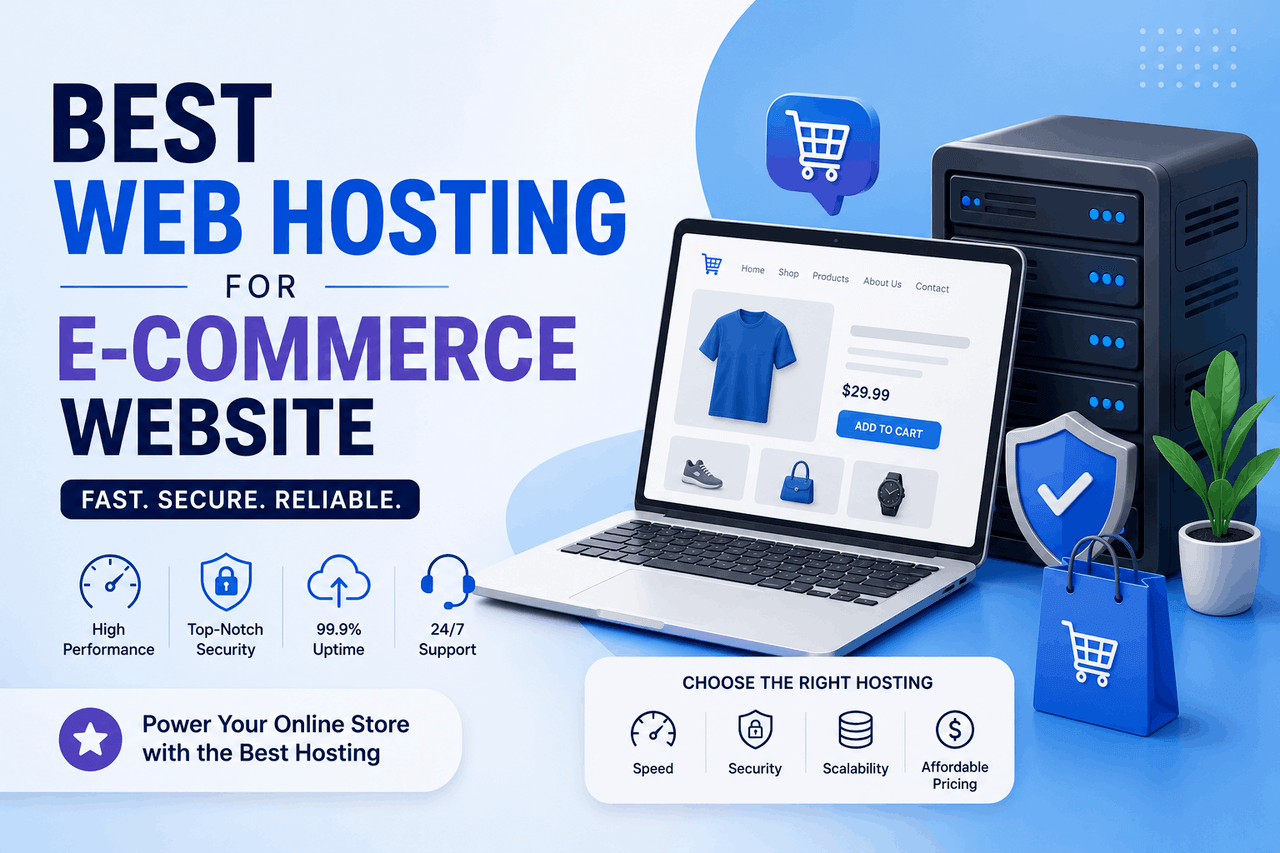
The best web hosting for an e-commerce website depends on your technical expertise and traffic volume. Shopify provides the best managed hosting for beginners who want an all-in-one solution. Choose SiteGround for WooCommerce integration, Hostinger for affordable starting prices, or BigCommerce for complex, high-volume enterprise stores.
Running an online store requires a solid foundation. In the retail world, your web host is the physical building that houses your merchandise. If the foundation cracks, the doors stick, or the lights go out, customers leave. Your web host dictates how fast your pages load, how secure your customer data remains, and how many shoppers your site can handle during a holiday rush.
A standard blog can survive a few minutes of downtime. An e-commerce website cannot. Every second of delay directly impacts your revenue. Finding a web hosting provider built specifically for online retail ensures you avoid costly outages and sluggish checkout processes.
The e-commerce hosting market is crowded, with hundreds of companies claiming to offer the fastest speeds and the best uptime. Sifting through marketing claims to find the truth requires understanding exactly what an online store demands from a server. This guide breaks down the essential features of e-commerce hosting, reviews the top providers, and helps you match the right service to your business goals.
What key features should you look for in e-commerce hosting?
Your online store requires specific technical capabilities that standard shared hosting may not always provide. You will want to evaluate every potential web host against three strict criteria.
Uptime and reliability
Downtime costs you money immediately. Look for a web host that guarantees at least 99.9% uptime. That 0.1% difference matters. A 99% uptime guarantee allows for over three days of downtime per year, while a 99.9% guarantee limits downtime to about eight hours annually.
Server speed and performance
Slow websites kill sales. According to [Portent, 2022], an e-commerce site that loads in 1 second sees a conversion rate 2.5 times higher than one that loads in 5 seconds. You need a host that uses solid-state drives (SSDs) and includes a content delivery network (CDN). A CDN stores copies of your site on servers around the world, ensuring a shopper in London loads your site just as fast as a shopper in New York.
Sufficient bandwidth and storage
High-quality product images and video demonstrations consume significant storage space. Traffic spikes during seasonal sales consume bandwidth. You need hosting that offers generous storage and unmetered bandwidth so your site doesn’t crash when a product goes viral.
What are the top web hosting providers for e-commerce websites?
Not all web hosting providers structure their services the same way. Some bundle the host with the store builder, while others provide raw server space for you to install your own software. Here is a breakdown of four leading options.
Shopify
Overview
Shopify is a fully hosted e-commerce platform. You pay a monthly fee, and Shopify handles all the server maintenance, security updates, and software installations. You do not need to buy separate web hosting, as it is built into the software.
Who is this for?
Shopify is ideal for business owners who want to launch a store quickly without touching server settings or managing software updates. It suits beginners and large brands alike who prefer an all-in-one software ecosystem.
Risks
You give up deep control over your server environment. You cannot access the backend server files, and you are tied exclusively to Shopify’s infrastructure. If you decide to move your store to a different software platform later, migrating your data takes significant effort.
Rewards
You get peace of mind. Shopify guarantees 99.99% uptime and handles massive traffic spikes effortlessly. Their infrastructure processes billions of dollars in transactions annually, meaning you never have to worry about server configuration.
SiteGround
Overview
SiteGround is a traditional web hosting provider known for its tight integration with WordPress and WooCommerce. They offer specific WooCommerce hosting plans that include automated installations, daily backups, and built-in caching for faster page loads.
Who is this for?
SiteGround works best for store owners who want the flexibility of WordPress and the control of owning their own server environment. It is a great middle ground for those with moderate technical skills who want premium support.
Risks
SiteGround sets strict limits on storage space and monthly visits. Their entry-level plan caps storage at 10 GB and limits traffic to roughly 10,000 monthly visits. If your store grows rapidly, you will need to upgrade to a more expensive tier sooner than you might with other hosts.
Rewards
You get exceptional customer support and highly tuned WordPress performance. SiteGround includes free automated daily backups and a free CDN, which makes managing a WooCommerce store much easier.
Hostinger
Overview
Hostinger provides highly affordable shared and cloud hosting plans. They offer specific e-commerce packages that include free domain registration, automated backups, a drag-and-drop website builder, and WooCommerce compatibility.
Who is this for?
Hostinger is the best choice for new entrepreneurs operating on a tight budget. If you are starting a side hustle or testing a new product concept, Hostinger allows you to get online with minimal financial risk.
Risks
The heavily advertised low prices require you to commit to a 48-month contract. When that initial term expires, the renewal rates jump significantly. Shared hosting plans also mean your site shares resources with other websites, which can slow down your store if a neighbouring site experiences a traffic spike.
Rewards
You keep your initial startup costs incredibly low. Hostinger includes a free SSL certificate, a free domain for the first year, and an intuitive control panel that makes launching your first store straightforward.
BigCommerce
Overview
BigCommerce operates similarly to Shopify as a fully hosted, all-in-one e-commerce platform. It provides enterprise-grade server infrastructure and includes many advanced sales features out of the box without requiring paid plugins.
Who is this for?
BigCommerce is designed for established businesses managing large product catalogues and complex inventory requirements. It suits business-to-business (B2B) sellers and merchants managing multiple storefronts from a single account.
Risks
The platform enforces annual sales limits on its pricing tiers. If your store generates over $50,000 in a year, BigCommerce forces you to upgrade to a more expensive plan. The interface also carries a steeper learning curve than beginner-focused platforms.
Rewards
You gain access to a highly scalable infrastructure with zero transaction fees. BigCommerce integrates natively with multiple payment gateways and provides built-in tools for international selling.
What advanced e-commerce hosting considerations matter most?
Beyond the basic requirements of speed and uptime, running an online store introduces complex challenges regarding data protection and business growth.
How does security protect your online store?
Your e-commerce website handles sensitive customer data, including physical addresses and credit card numbers. A security breach destroys customer trust and can result in severe financial penalties. Look for a web hosting provider that includes a free SSL certificate. This encrypts data passed between the customer’s browser and your server.
You also need a host that provides automated daily backups, proactive malware scanning, and a web application firewall (WAF). According to [IBM, 2023], the global average cost of a data breach is over $4 million. Paying a few extra dollars a month for a host with strict security protocols is a necessary insurance policy.
Why is scalability critical for e-commerce growth?
E-commerce traffic is rarely consistent. A successful marketing campaign or the holiday shopping season can send a massive surge of visitors to your site. If your web host limits your server resources, your site will crash exactly when you stand to make the most money.
You need a web hosting provider that offers seamless upgrades. This means you can move from a shared hosting plan to a virtual private server (VPS) or a dedicated server without experiencing downtime. Cloud hosting offers the best scalability, allowing you to automatically scale up during traffic spikes and scale back when traffic normalises.
What level of customer support do you need?
When a technical error prevents shoppers from checking out at 2:00 AM on a Sunday, you cannot wait until Monday morning for an email reply. You need a web host that provides 24/7 customer support through live chat or phone. The support team must be knowledgeable about e-commerce, specifically, not just general server maintenance.
How do you choose the right e-commerce host for your business?
Selecting the right web hosting provider requires matching the service to your specific constraints. Use these decision criteria to guide your choice.
Choose Shopify if speed to market matters more than server control. It removes the technical friction of launching a store.
Choose SiteGround if you require the flexibility of WordPress and WooCommerce but want a host that manages the complex technical details.
Choose Hostinger if your primary constraint is a tight starting budget and you are willing to commit to a long-term contract to secure low rates.
Choose BigCommerce if you manage complex B2B sales or have a massive product catalogue that requires advanced filtering and variation tracking.
Making your final e-commerce hosting decision
Your web host serves as the silent partner in your retail business. It dictates how customers experience your brand and determines whether your site can survive its own success.
Evaluate your current technical skills, estimate your expected monthly traffic, and set a clear monthly budget. Do not compromise on security features or uptime guarantees to save a few dollars. By selecting a web hosting provider built specifically for the demands of online retail, you protect your revenue and create a smooth, reliable shopping experience for your customers.
FAQs about e-commerce hosting.
How much does e-commerce hosting usually cost?
The cost of e-commerce hosting varies widely based on the infrastructure. Shared hosting for a small store usually costs between $3 and $10 per month. Managed WooCommerce hosting or platform-based hosting, like Shopify, ranges from $29 to $40 per month. Dedicated servers for high-volume stores can cost over $200 per month.
How long does it take to migrate an existing online store?
Migrating an existing store to a new web host typically takes between 24 and 48 hours. Most high-quality hosting providers offer free migration services where their technical team moves your database and files. The actual downtime during the DNS switch is usually limited to a few hours.
What are the risks of using cheap shared hosting?
Shared hosting places your online store on the same server as hundreds of other websites. If another site experiences a massive traffic spike or a malware infection, it drains the server’s resources. This slows down your page load speeds, frustrates your shoppers, and can cause your site to crash entirely.
What are the best alternatives to fully managed e-commerce hosting?
If you do not want an all-in-one platform like Shopify, the best alternative is using a self-hosted content management system like WordPress paired with WooCommerce. You will need to purchase a reliable hosting plan from a provider like SiteGround, but you retain complete ownership of your software and data.