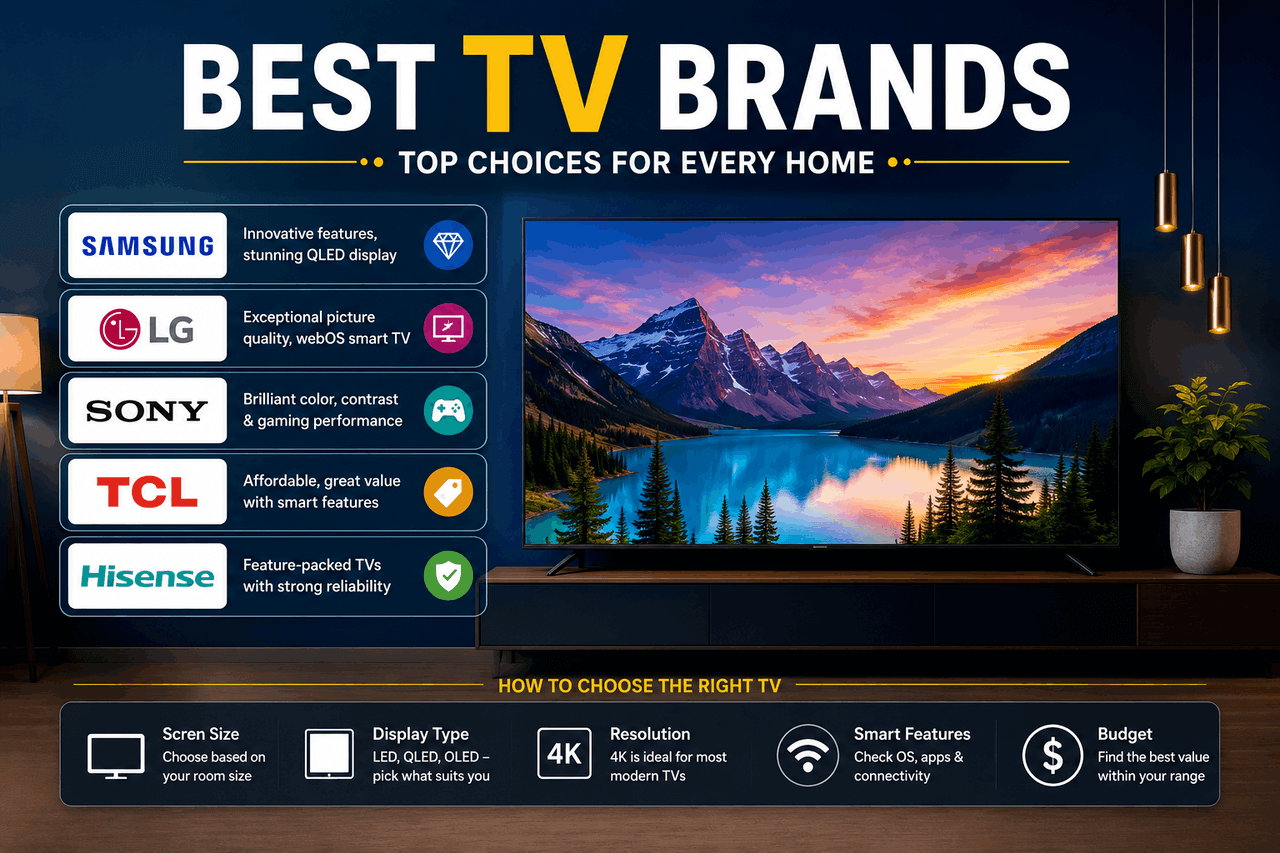
The best TV brands are Samsung, LG, Sony, TCL, and Hisense. Samsung and LG lead on display technology, Sony excels in picture processing, and TCL and Hisense offer strong performance at lower price points. Your best pick depends on your budget, preferred picture technology, and smart TV ecosystem.
The TV market has never been more crowded—or more confusing. Manufacturers refresh their lineups every year, and the gap between flagship and budget models keeps narrowing. That’s good news for buyers, but it also makes choosing harder.
Pick the wrong brand, and you’re stuck with a display that doesn’t suit your room, a smart TV platform you can’t stand, or a price tag that didn’t buy you as much as you expected. Pick the right one, and you get years of genuinely enjoyable viewing.
This guide cuts through the noise. Below, you’ll find a plain-language breakdown of the top TV brands—what each one does well, where each one falls short, and whom each one is best suited for. Whether your budget is $300 or $3,000, there’s a brand here that fits your situation.
What should you actually look for when buying a TV?
Before diving into brand specifics, it helps to know what separates a good TV from a great one. Five factors matter most.
Picture quality is the most obvious. Look for high contrast ratios, accurate colours, and strong performance in both bright rooms and dark ones. Display technology—OLED, QLED, LED—drives most of this.
Sound is easy to overlook. Built-in speakers on thin TVs often disappoint, but some brands invest more in audio engineering than others. If you’re not planning to add a soundbar, this matters.
Smart TV platform determines how easy your TV is to use day to day. A clunky interface or a platform that drops app support after two years will wear on you faster than you’d expect.
Size and room fit matter more than most buyers account for. A 75-inch screen sounds appealing, but in a small room with close seating, it’s overwhelming. Measure your space and calculate viewing distance before you commit.
Budget shapes everything else. The good news: strong value options now exist at nearly every price point. The premium brands still justify their cost, but you don’t have to spend top dollar to get a good picture.
The top TV brands: a deep dive
Samsung: the widest range, from lifestyle TVs to flagship QLED
Samsung is the world’s largest TV manufacturer by sales volume, and its lineup reflects that scale—from budget-friendly entry models to the Neo QLED 8K sets at the top end.
Samsung’s strength lies in its QLED and Neo QLED technology. QLED uses quantum dots to boost colour and brightness on an LED panel, which means Samsung TVs perform particularly well in bright rooms. Neo QLED adds Mini LED backlighting, giving Samsung flagships tighter contrast control than older LED designs. The result is a TV that handles HDR content well and stays vivid under overhead lighting.
That said, QLED still can’t fully match OLED for deep blacks and per-pixel contrast. If you watch a lot of content in a darkened room, that gap is visible.
Samsung also makes the Frame TV and other lifestyle models—sets designed to look like artwork when not in use. These are a genuine option if aesthetics matter as much as performance, though you pay a premium for the design.
The Tizen smart TV platform is one of the more polished on the market. It’s fast, app support is broad, and Samsung updates its software reliably.
Best for: Buyers who want premium brightness, strong HDR performance, and a well-supported smart platform—especially in rooms with lots of natural light.
LG: the OLED benchmark, with strong mid-range options too
LG builds the panels that power OLED TVs across the industry, including many sets sold by other brands. That matters because LG’s own OLED lineup—the C-series, G-series, and beyond—sits at or near the top of most expert rankings for picture quality.
OLED technology allows each pixel to produce its own light and switch off completely, delivering true blacks and infinite contrast ratios. That makes LG OLED TVs exceptional for movies, especially in dimly lit rooms. Motion handling is also strong, which benefits sports and gaming.
The trade-off is brightness. LG OLED panels are getting brighter every year, but in very bright rooms, a high-end Samsung QLED may still outshine them—literally. OLED panels can also experience burn-in over time if the same static image sits on screen for extended periods, though this is less of a concern with normal, varied viewing.
Below the OLED tier, LG’s NanoCell and QNED lines offer solid mid-range options. They’re not as impressive as LG’s own OLEDs, but they compete reasonably well against similarly priced models from other brands.
LG’s webOS platform is intuitive and well-supported, with a wide app library and easy navigation.
Best for: Movie lovers and gamers who prioritise picture quality in a controlled lighting environment, and buyers who want the best OLED panel available.
Sony: precise picture processing, powered by Google TV
Sony doesn’t manufacture its own display panels—it buys OLED panels from LG and LED panels from other suppliers. What Sony adds is its own processing layer: the Cognitive Processor XR, which the company says mirrors how human vision perceives depth, texture, and colour.
In practice, Sony TVs tend to produce more natural, filmic images than comparably priced sets from Samsung or LG. Skin tones look accurate. Motion is handled smoothly without the artificial over-processing that some viewers find distracting. For those who care about cinematic accuracy, Sony has a strong track record.
Sony Bravia sets run Google TV, one of the most app-rich smart platforms available. Google TV integrates streaming recommendations across services in a single interface, which works well if you subscribe to multiple platforms.
The honest downside: Sony charges a premium for its processing reputation, and at the same budget, you may get a physically larger screen from TCL or Hisense. Sony TVs also don’t typically reach the peak brightness of Samsung flagships.
Best for: Viewers who prioritise natural, accurate picture reproduction—particularly those who watch a lot of film content and want a mature, well-integrated smart platform.
TCL: Roku TV integration and strong value at every price point
TCL has grown rapidly outside China and now holds a significant share of the North American market. The reason is straightforward: TCL delivers respectable picture quality at prices that often undercut the major brands by a wide margin.
Most TCL sets sold in the US run Roku TV, which is one of the most user-friendly smart platforms available. Roku’s interface is simple and responsive, its app selection is comprehensive, and Roku doesn’t clutter the home screen with intrusive advertising like some platforms do.
TCL’s mid-range and higher-end models use Mini LED backlighting with local dimming zones, which narrows the gap with premium brands on contrast and HDR performance. At the top of the TCL range, QM-series sets punch well above their price.
That said, TCL’s build quality and finish are a step below Sony’s or Samsung’s at equivalent screen sizes, and software support over time has historically been less consistent than the major brands.
Best for: Budget-conscious buyers who want a solid picture and a no-fuss smart platform, without paying for a brand premium.
Hisense: ULED, Laser TV, and aggressive pricing
Hisense is the other major challenger brand, and it competes aggressively on price. Like TCL, Hisense offers Mini LED technology in its upper-tier ULED models, giving buyers a reasonable path to strong contrast and brightness without flagship prices.
Where Hisense stands apart is its Laser TV lineup—ultra-short-throw laser projectors designed to function as large-screen TVs. For buyers who want a 100-inch-plus screen without a traditional projector setup, Laser TV is one of the few practical options.
Standard Hisense TVs are a reasonable choice for large-screen buyers on a tight budget. However, colour accuracy and consistent performance across the lineup vary, and Hisense’s smart TV platform (VIDAA) has a smaller app library than Roku, Google TV, or Tizen.
Best for: Buyers prioritising screen size per dollar, and those curious about Laser TV technology as an alternative to large-panel displays.
What’s coming next: 8K, Mini LED, and QD-OLED
Three trends are shaping the direction of TV technology.
8K has been on the horizon for years, but hasn’t reached mainstream viability yet. Native 8K content is scarce, and most 4K-to-8 K upscaling produces marginal gains that are hard to notice at typical viewing distances. 8K TVs carry significant price premiums that are hard to justify for most buyers today.
Mini LED is the more practical development. By packing thousands of tiny LEDs behind the panel, manufacturers can control backlighting with far greater precision, producing deeper blacks and brighter highlights than traditional LED designs. Mini LED sets from Samsung, TCL, and Hisense have significantly narrowed the premium-budget gap.
QD-OLED combines quantum dot technology with an OLED panel, producing displays with higher brightness than traditional OLED while retaining the per-pixel contrast OLED is known for. Samsung and Sony both offer QD-OLED sets, and the technology is improving quickly. It currently sits at the upper end of the price range, but costs will likely fall over the next few years.
So, which TV brand should you buy?
There’s no single best brand—there’s a best brand for your situation.
If picture accuracy and film-watching are your priorities, LG OLED or Sony Bravia are the clearest choices. If you watch in a bright room and want strong HDR performance, Samsung Neo QLED is worth the investment. If your budget is tight but you still want a capable TV with a reliable smart platform, a TCL Roku TV is a practical pick. And if you want maximum screen size per dollar, Hisense deserves a look.
The technology across all five brands is genuinely good in 2025. Spend time with your specific priorities—room conditions, content habits, budget—and the right brand becomes obvious.
FAQs about the best TV brands
Which TV brand has the best overall picture quality?
LG and Sony consistently rank highest for picture quality. LG leads with OLED panel technology, which delivers true blacks and infinite contrast. Sony adds its Cognitive Processor XR for natural image accuracy. Samsung’s Neo QLED models are the closest competition, particularly in bright environments.
Is OLED or QLED better for a TV purchase?
OLED is generally better for dark rooms and movie watching, thanks to its per-pixel contrast and deep blacks. QLED tends to be brighter, making it a stronger choice for well-lit rooms. QD-OLED, now available from Samsung and Sony, narrows the gap by combining both technologies.
Are TCL and Hisense good TV brands, or should I spend more?
TCL and Hisense are legitimate options, not compromise buys. Both brands offer Mini LED technology in their mid- to upper-range models, and TCL’s Roku TV integration is one of the best smart platforms available. That said, build quality and long-term software support are generally stronger with Samsung, LG, and Sony.
Is 8K TV worth buying?
For most buyers, no. Native 8K content remains extremely limited, and the visual difference between 4K and 8K upscaling is difficult to detect at typical viewing distances. The price premium for 8K currently outweighs the practical benefit for the vast majority of viewers.
What smart TV platform is the easiest to use?
Roku TV (found on TCL and some Hisense models) is frequently cited as the most intuitive. Google TV (Sony) offers the broadest integration with streaming services. Samsung’s Tizen and LG’s webOS are both polished and reliable. VIDAA on Hisense has a smaller app library than the others.
How do I choose the right TV size for my room?
A general rule: your viewing distance in inches, divided by 1.5 to 2, gives you a good range of screen sizes. For example, a 9-foot (108-inch) viewing distance suggests a screen between 54 and 72 inches. Sitting too close to a large screen makes individual pixels visible and causes eye fatigue.