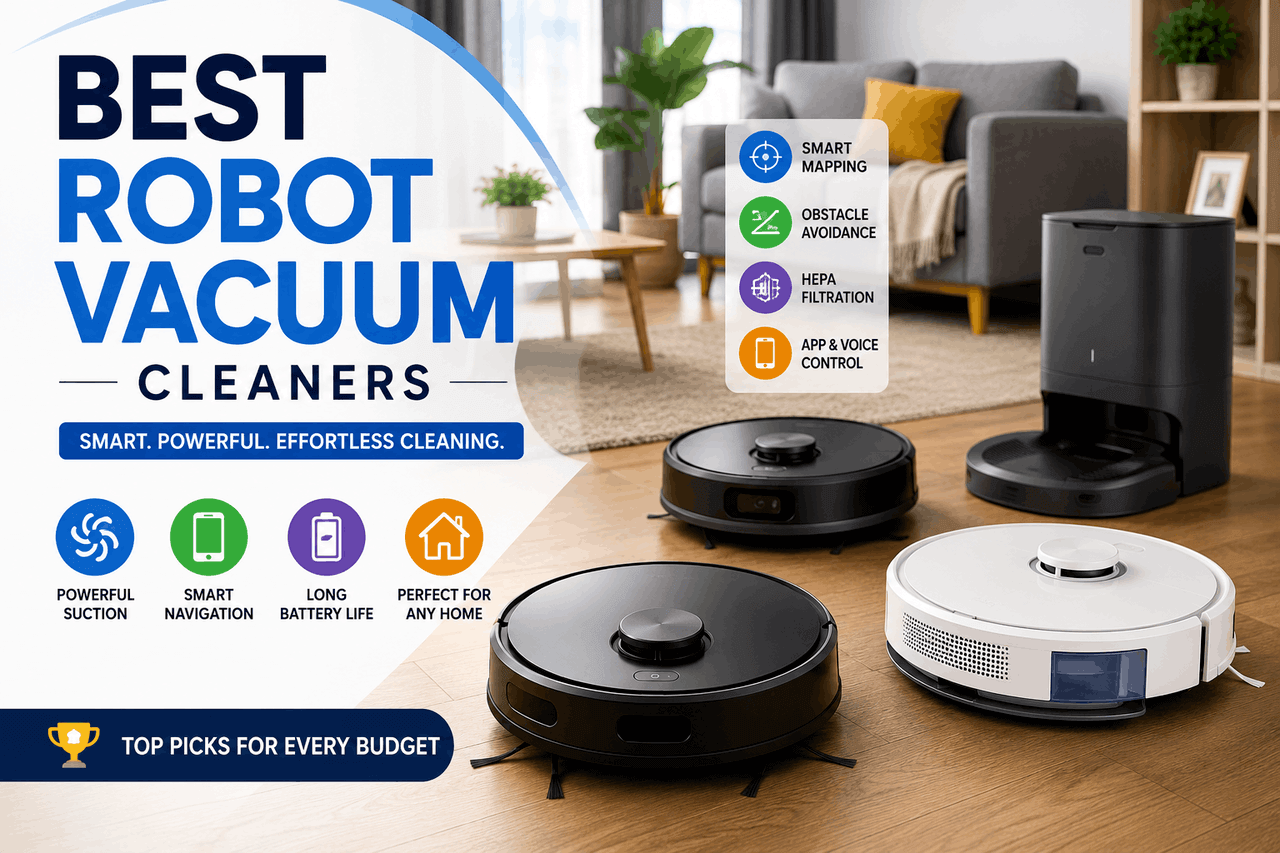
The best robot vacuum cleaners combine strong suction, smart navigation, and self-emptying capabilities to automate floor cleaning. The Roborock S7 MaxV Ultra and iRobot Roomba s9+ lead the high-end market for deep cleaning and obstacle avoidance. Mid-range options like the Shark IQ Robot offer self-emptying on a budget, while the Eufy RoboVac 11S is the best affordable choice for basic, everyday sweeping. Choose a model based on your floor type, pet situation, and budget.
Robot vacuums are the cruise control of home cleaning. They take a tedious, repetitive chore and handle the bulk of it, giving you back hours of your week. You set the schedule, and the machine does the work.
If you are tired of spending your weekends pushing a heavy upright vacuum around your living room, a robot vacuum is an excellent alternative. These devices have evolved from clumsy plastic discs that bounce off your furniture into sophisticated machines capable of mapping your home and avoiding obstacles. But adding a robot vacuum to your home requires a significant investment, and the market is flooded with options ranging from $150 basic sweepers to $1,500 automated cleaning stations.
This guide will break down exactly how these devices work, what features actually matter, and which specific robot vacuum cleaner makes the most sense for your floor plan and budget.
What are robot vacuums and how do they work?
A robot vacuum is an autonomous cleaning device that sweeps and vacuums floors without human intervention. They operate using a combination of electric motors for suction, spinning brushes to gather debris, and sensors to navigate your home.
The benefits of owning a robot vacuum centre are entirely based on convenience and time-saving efficiency. You can program the iRobot Roomba or Roborock vacuum to run while you are at work. You come home to clean floors without lifting a finger. While a robot vacuum will not replace the need for an occasional deep clean with a traditional vacuum, it maintains a baseline level of cleanliness, preventing dust, dirt, and pet hair from accumulating.
What factors should you consider before buying a robot vacuum?
Buying a robot vacuum means navigating a long list of technical specifications. You need to understand which features align with your specific home environment.
How do suction power and brush types affect cleaning?
Suction power is measured in Pascals (Pa). A higher Pa number indicates a stronger motor. If your home is mostly hard floors, a robot vacuum with 1,500 to 2,000 Pa suction power is sufficient. If you have thick carpets, you will want a model with at least 2,500 Pa to pull dirt from the fibres.
Brush type matters just as much as suction. Rubber roller brushes, found on most iRobot Roomba models, resist hair tangles much better than traditional bristle brushes. Choose rubber rollers if you have pets that shed frequently.
What are the different navigation and mapping capabilities?
Early robot vacuums navigated by bumping into walls and changing direction. Modern robot vacuums use advanced mapping technology to clean in neat, efficient rows.
- LIDAR (Light Detection and Ranging): The vacuum uses invisible lasers to scan the room and create a highly accurate floor plan. LIDAR is excellent for navigating in the dark.
- vSLAM (Visual Simultaneous Localisation and Mapping): The vacuum uses an onboard camera to map your ceiling and walls. It works well but requires ambient light to “see” where it is going.
- Bumper sensors: These are found on budget models. The vacuum moves randomly until it hits an object, then turns. This takes longer and often misses spots.
How much battery life and charging capacity do you need?
Battery life determines how much area the robot vacuum can clean in a single session. Most models run for 90 to 120 minutes. If you have a large home, look for a feature called “auto-recharge and resume.” This allows the vacuum to return to its dock when the battery is low, charge up, and then pick up exactly where it left off.
What smart features actually matter?
Smart features dictate how you interact with the machine. App control allows you to start, stop, and schedule cleanings from your smartphone. Voice assistant integration lets you start the vacuum using Amazon Alexa or Google Assistant.
The most valuable smart feature is the ability to create “no-go zones.” Using the app, you can draw invisible barriers to keep the vacuum away from delicate furniture, pet bowls, or tangled power cords.
Are self-emptying docks and dustbin capacity worth the cost?
A standard robot vacuum dustbin holds about 400-600 millilitres of dirt. You have to empty it manually after every cleaning.
Self-emptying docks change the equation. When the robot finishes cleaning, it returns to the dock, which uses a secondary motor to suck the dirt out of the robot and into a larger disposable bag. These bags usually hold 30 to 60 days’ worth of debris. Choose a self-emptying dock if you have allergies or if you want a truly hands-off experience.
What price range and warranty should you expect?
Robot vacuums cost anywhere from $150 to over $1,500. Budget models ($150 to $300) offer random navigation and basic suction. Mid-range models ($300 to $600) introduce smart mapping and occasionally self-emptying docks. High-end models ($700 to $1,500+) feature advanced obstacle avoidance, mopping capabilities, and premium self-emptying stations. Most reputable brands offer a one-year limited warranty.
What are the top robot vacuum cleaners of 2024?
The best robot vacuum for you depends heavily on your budget and your home’s layout. Here is a breakdown of the top performers across different price tiers.
What are the best high-end robot vacuums?
High-end models offer the most autonomy. They learn your home, avoid small obstacles like shoes or pet waste, and require very little maintenance.
iRobot Roomba s9+
- Overview: The Roomba s9+ is iRobot’s most powerful vacuum. It features a D-shape design that allows it to reach deep into corners.
- Who is this for: Choose the Roomba s9+ if you have thick carpets and need maximum suction power.
- Rewards: It offers exceptional deep-cleaning capabilities and features a robust self-emptying base. The dual rubber brushes handle pet hair perfectly.
- Risks: It operates quite loudly on the highest suction setting, and the navigation camera requires light to work.
Roborock S7 MaxV Ultra
- Overview: This hybrid machine vacuums and mops simultaneously. Its dock empties the dustbin, washes the mop pad, and refills the water tank.
- Who is this for: Choose the Roborock S7 MaxV Ultra if your home has a mix of hard floors and carpets.
- Rewards: It uses an AI camera to recognise and avoid obstacles, such as charging cables. The ultrasonic sensor detects carpet and automatically lifts the mop pad, keeping your rugs dry.
- Risks: The docking station is massive and requires a significant amount of floor space. The price tag is usually well over $1,000.
What are the best mid-range robot vacuums?
Mid-range models give you smart mapping and reliable cleaning without the premium price tag of flagship models.
Shark IQ Robot Self-Empty XL
- Overview: Shark brings self-emptying technology down to a more accessible price point.
- Who is this for: Choose the Shark IQ if you want hands-free dustbin emptying but do not want to spend more than $500.
- Rewards: The bagless self-emptying base means you do not have to buy replacement bags. It cleans in neat rows and handles hard floors very well.
- Risks: The app is basic compared to iRobot or Roborock, and the navigation can occasionally become confused in complex room layouts.
Ecovacs Deebot N8 Pro+
- Overview: The N8 Pro+ combines a vacuum, a basic mop, and a self-emptying station into one package.
- Who is this for: Choose the Ecovacs Deebot N8 Pro+ if you want LIDAR navigation and a self-emptying base at a moderate price.
- Rewards: The LIDAR mapping is incredibly fast and accurate. It rarely gets stuck, and the suction power is strong enough for medium-pile carpets.
- Risks: The mopping feature is simply a wet pad dragged behind the robot. It is fine for light dust, but it will not scrub away dried spills.
What are the best budget-friendly robot vacuums?
Budget models lack smart mapping, meaning they bounce around randomly. But they still pick up a surprising amount of daily dust and hair.
Eufy RoboVac 11S
- Overview: The Eufy 11S is a slim, quiet, “bump-and-turn” robot vacuum.
- Who is this for: Choose the Eufy 11S if you live in a small space and want a simple machine to keep the floors tidy.
- Rewards: It is incredibly quiet. You can easily watch television while it runs in the same room. Its slim profile allows it to fit under low-clearance furniture.
- Risks: It does not map your home, so it may clean the same area twice and miss another spot entirely. You cannot set no-go zones.
iRobot Roomba 694
- Overview: The Roomba 694 is iRobot’s entry-level model, offering app connectivity and the classic Roomba bristle brushes.
- Who is this for: Choose the Roomba 694 if you want the reliability of the iRobot brand on a tight budget.
- Rewards: The build quality is excellent, and replacement parts are widely available. The iRobot app is highly intuitive.
- Risks: The bristle brushes require frequent manual cleaning to remove tangled hair. It navigates randomly and takes a long time to clean multiple rooms.
Which specialised robot vacuum is right for your home?
Sometimes you have a specific problem that needs solving. Here is how to match the machine to the environment.
Which robot vacuum is best for pet hair?
Choose the iRobot Roomba j7+. It features dual multi-surface rubber brushes that resist tangles. Furthermore, iRobot guarantees its front-facing camera will identify and avoid solid pet waste.
Which robot vacuum is best for hardwood floors?
Choose the Roborock Q Revo. Hardwood floors require more sweeping and mopping than deep suction. The Q Revo features dual spinning mop pads that actively scrub hard floors, leaving a polished finish without damaging the wood.
Which robot vacuum is best for carpets?
Choose the iRobot Roomba s9+. Its D-shape design provides a wider cleaning path, and its motor delivers the deepest suction to pull embedded dirt from carpet fibres.
Which robot vacuum is best for small apartments?
Choose the Eufy RoboVac 11S. In a small space, you do not need advanced LIDAR mapping to find every corner. The 11S is compact, quiet, and highly affordable.
Which robot vacuum is best for smart homes?
Choose the Roborock S8 Pro Ultra. The Roborock app offers the most granular control available, allowing you to adjust suction, water flow, and cleaning sequences per room. It integrates seamlessly with Google Home, Amazon Alexa, and Apple Siri Shortcuts.
How should you maintain your robot vacuum?
A robot vacuum takes care of your floors, but you have to take care of the robot vacuum. Neglecting maintenance will severely reduce the machine’s suction power and lifespan.
First, clean the brushes and filters. Hair and string will inevitably wrap around the main roller brush. Most manufacturers include a small razor tool to slice the hair away. You should do this once a week. The paper filter inside the dustbin also gets clogged with fine dust. Tap the filter against your trash can every few days to keep the airflow clear. Replace the filter entirely every three months.
Second, you must empty the dustbin. If you do not have a self-emptying dock, empty the onboard dustbin after every single cleaning cycle. A full dustbin prevents the vacuum from picking up new dirt.
Finally, keep the sensors clean. The robot relies on infrared sensors on its bumper and underneath its chassis to avoid falling down stairs. Wipe these sensors with a dry microfiber cloth once a month to prevent navigation errors. If your robot vacuum starts acting confused or driving in circles, a dirty sensor is usually the culprit.
Making the right choice for your home
Adding a robot vacuum to your daily routine changes the way you maintain your home. You trade the manual labour of pushing a heavy machine for the much lighter task of occasional maintenance and app scheduling.
Before making a purchase, assess your floor plan. If you have a large home with a complex layout, invest in a model with LIDAR or vSLAM mapping. If you have pets, prioritise rubber roller brushes and a self-emptying dock. If you live in a small, uncluttered apartment, a budget bump-and-turn model will serve you perfectly well.
The technology powering robot vacuums continues to advance rapidly. Obstacle avoidance is becoming standard, and hybrid vacuum-mop models are growing more competent. By understanding your specific needs and matching them to the right features, you can find a machine that keeps your floors consistently clean.
FAQs about Robot Vacuums
Do robot vacuums use a lot of electricity?
No. Robot vacuums are highly energy efficient. They draw a small amount of power to charge the battery and a minimal trickle charge to stay connected to your Wi-Fi network while docked.
How long do robot vacuums typically last?
A well-maintained robot vacuum typically lasts between four and six years. You will likely need to replace the rechargeable battery after two or three years, as lithium-ion batteries naturally degrade over time.
Can robot vacuums go over floor transitions?
Yes. Most modern robot vacuums can easily cross floor thresholds and transition strips up to 0.75 inches (about 2 centimetres) high. If your transitions are steeper than that, the vacuum will recognise them as walls and turn around.
Will a robot vacuum fall down the stairs?
No. All modern robot vacuums come equipped with downward-facing “cliff sensors.” These sensors detect when the floor drops away and immediately stop the vacuum from moving forward, instructing it to back up and turn around.
Do I still need a regular vacuum if I buy a robot vacuum?
Yes. A robot vacuum is designed for daily maintenance cleaning. You will still need a traditional upright or stick vacuum to clean stairs, upholstery, and hard-to-reach crevices, as well as to perform occasional deep cleans on thick carpets.