
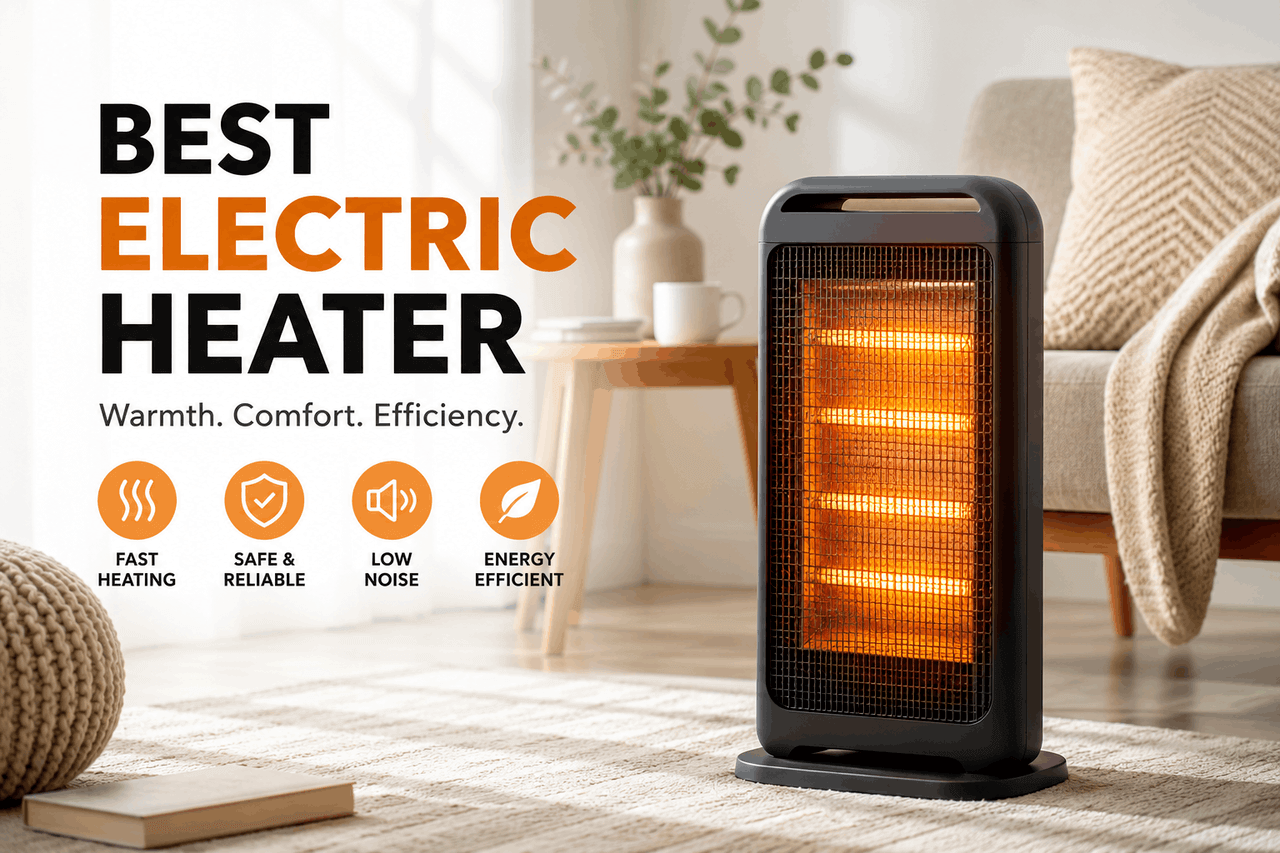
Best Electric Heater For Large Room

best electric heater

Table of Contents

Placeholder

Heading Text Here

Lorem ipsum dolor sit amet, consectetur adipiscing elit.

Lorem ipsum dolor sit amet, consectetur adipiscing elit. Ut elit tellus, luctus nec ullamcorper mattis, pulvinar dapibus leo.

Lorem ipsum dolor sit amet, consectetur adipiscing elit. Ut elit tellus, luctus nec ullamcorper mattis, pulvinar dapibus leo.

The best electric heater for a large room depends on your specific needs. Infrared heaters like the Dr Infrared Portable Heater deliver fast, targeted warmth. Oil-filled radiators like the De’Longhi Comfort Temp are ideal for silent, consistent heating across spaces larger than 400 square feet.Heating a large room presents a unique physical challenge. Cold air settles, drafts pull warmth through window panes, and tall ceilings trap the heat you actually want near the floor. You find yourself turning up the central thermostat, wasting money to heat the entire house to make one room comfortable.Electric space heaters solve this problem by providing targeted warmth exactly where you need it. They plug into standard 120-volt wall outlets and convert electricity directly into heat. This allows you to lower your home’s main thermostat and rely on zone heating. Zone heating saves money.Finding the right unit requires understanding how different heating technologies interact with large spaces. An electric heater that works perfectly under a home office desk will fail in a 500-square-foot living room with vaulted ceilings. This guide breaks down exactly how to evaluate your space, which heating technologies work best, and how to choose the right electric heater for your large room.


How do you calculate heating needs for large rooms?

Before buying an electric heater, you need to define the space you want to heat. A “large room” typically refers to any enclosed area between 400 and 1,000 square feet. Open-concept living rooms, finished basements, and primary bedroom suites usually fall into this category.

What factors affect heating efficiency in large spaces?

Square footage is only the baseline. You must also account for the room’s physical characteristics. A poorly insulated room will lose heat almost as fast as an electric heater can generate it. High ceilings present another problem. Because hot air rises, a room with 12-foot ceilings contains 50% more air volume than a room with standard 8-foot ceilings, even if the floor space is identical.Drafty windows and exterior walls also pull heat away from the centre of the room. If your large room sits above an uninsulated garage, the cold floor will constantly absorb the ambient heat. You must factor these structural elements into your buying decision.

How do BTUs and wattage determine heating capacity?

Electric heaters measure their power in watts, and their heat output in British Thermal Units (BTUs). A standard space heater draws up to 1,500 watts of electricity. This 1,500-watt draw translates to roughly 5,118 BTUs of heat output.As a general rule, you need 10 watts of heating power per square foot of space. A 1,500-watt electric heater can effectively warm a 150-square-foot room under average conditions. For a 400-square-foot room, a single 1,500-watt heater will struggle as a primary heat source. In these large spaces, you use the electric heater for supplemental heating—warming the area where you sit, rather than trying to raise the entire room’s temperature wall-to-wall.

Which types of electric heaters are suitable for large rooms?

Different heaters distribute heat in different ways. The right choice depends entirely on whether you want to heat the room or just the people in it.

How do convection heaters warm large areas?

Overview: Convection heaters draw in cold air from the floor, warm it over an internal heating element, and release it back into the room. As warm air rises, it pushes cooler air down, heating it in a continuous cycle.Who is this for? You will want a convection heater if you need to gradually and silently raise the ambient temperature of an entire enclosed room.Rewards: Convection models provide even heat distribution across an entire space. They operate silently because many models do not require a fan to move the air.Risks: They heat rooms slowly. You might wait an hour or more to feel a noticeable difference in a large room.

Why choose infrared heaters for targeted warmth?

Overview: Infrared heaters emit electromagnetic waves that warm physical objects directly. They heat your body and your furniture, rather than the air between you and the heater.Who is this for? You should choose an infrared heater if you sit in one specific spot in a large, drafty, or poorly insulated room.Rewards: Infrared technology provides instant warmth as soon as you turn the unit on. It works exceptionally well in large, drafty spaces because drafts cannot blow away infrared heat.Risks: The heat stops exactly where the light beam stops. If you move out of the heater’s direct line of sight, you will feel cold immediately.

Are fan-forced heaters effective in big rooms?

Overview: Fan-forced heaters use a metal heating element paired with an electric fan. The fan blows air over the hot element and pushes the warm air out into the room. The Vornado Vortex is a classic example of this technology.Who is this for? Fan-forced heaters are ideal if you want to circulate warm air quickly across a wide area.Rewards: They heat up rapidly and actively push warm air into cold corners.Risks: The fans generate noticeable background noise. They can also dry out the air in your room for extended periods of operation.

When should you use oil-filled radiators?

Overview: Oil-filled radiators look like old-fashioned cast-iron radiators. They use electricity to heat a reservoir of thermal oil sealed inside the metal fins. The hot oil warms the metal, which then radiates heat into the room.Who is this for? You will want an oil-filled radiator for spaces where you spend long periods, like a primary bedroom or a home office.Rewards: They are completely silent. Because the oil retains heat for hours, the radiator continues to warm the room long after the electric thermostat cycles off, saving you money on energy bills.Risks: They are heavy and take a long time to warm up. You will not feel instant heat when you turn them on.

What key features matter when choosing a large room heater?

Once you choose a heating technology, evaluate the specific features of the electric heater. Never buy a space heater based solely on looks.

How do you calculate the required heat output?

Always check the wattage. For a large room, you want a heater that maxes out at the standard 1,500 watts. Anything lower will struggle to make a difference in a space larger than 300 square feet. You will also want a heater with multiple power settings (usually 750 watts and 1,500 watts) so you can dial back the power draw when the room reaches your desired temperature.

Which energy efficiency features save money?

Running a 1,500-watt electric heater for eight hours a day can add $40 to $60 to your monthly electric bill. To control these costs, look for a heater with an ECO mode or a programmable digital thermostat. A digital thermostat allows you to set a precise room temperature—say, 70 degrees. The heater will run at full power until the room hits 70 degrees, then cycle down or shut off entirely to conserve electricity.

What safety features are necessary?

Electric heaters account for a high percentage of winter house fires. You must insist on modern safety features. Tip-over protection is mandatory. This mechanical switch instantly cuts power to the heating element if the unit gets knocked over by a pet or a child. Overheat protection is equally important. This internal sensor shuts the heater down if the internal components reach a dangerous temperature. Finally, look for a cool-touch exterior so you do not burn your hands when moving the unit.

Should you buy a portable or a stationary unit?

Portability matters if you plan to move the heater from the living room to the bedroom every night. Oil-filled radiators are heavy, usually weighing around 20 pounds, but they typically come with caster wheels for rolling. Infrared heaters often feature carrying handles. If you know the heater will live permanently in a basement or a garage, consider a wall-mountable electric convection heater to save floor space.

How much does noise level matter?

Noise tolerance depends on the room. A fan-forced heater in a busy living room might fade into the background noise of a television. That same fan-forced heater in a bedroom might keep you awake all night. If you need complete silence for sleeping or working, choose an oil-filled radiator or a pure convection heater.

Are smart features worth the extra cost?

Smart space heaters connect to your home’s Wi-Fi network. You can control them via smartphone apps or voice assistants like Amazon Alexa. This allows you to turn the heater on 30 minutes before you get out of bed in the morning. Choose this feature if you value scheduling and remote control, but be aware that smart heaters typically cost $50 to $100 more than manual models.

What are the best electric heaters for large rooms?

Based on heating capacity, safety features, and reliability, here are the top choices for large spaces.

Best Overall: Dr Infrared Heater Portable Space Heater

Overview: The Dr Infrared Heater combines quartz infrared elements with a quiet internal blower fan.Why it stands out: It delivers fast, direct infrared heat to your body while the fan circulates the residual warmth throughout the room. It features a digital thermostat, tip-over protection, and a cool-touch wooden cabinet. Choose the Dr Infrared if you want a versatile unit that provides immediate comfort in a large, drafty living room.Check Price on Amazon

Best for Energy Efficiency: De’Longhi Comfort Temp Oil-Filled Radiator

Overview: This De’Longhi model is a heavy-duty, 1,500-watt oil-filled radiator designed for continuous use.Why it stands out: It features a patented Comfort Temp button that automatically maintains the optimal room temperature, saving energy. Because the thermal oil stays hot long after the electricity shuts off, it draws far less power over eight hours than a fan-forced heater. Choose this model for a large bedroom that needs silent, efficient, all-night heating.

Best for Quick Heating: Vornado AVH10 Vortex Heater

Overview: Vornado uses a specialised fan design to create a vortex of air that rapidly circulates heat throughout a room.Why it stands out: Unlike traditional fan heaters that blow hot air in a straight line, the Vornado continuously pushes warm air out and pulls in cold air, creating a complete circulation pattern. Choose the Vornado if you need to quickly raise the ambient temperature in a large finished basement or open-concept room.

Best Quiet Operation: Lasko Silent Room Heater

Overview: The Lasko Silent Room Heater is a low-profile convection heater that operates without a fan.Why it stands out: It relies entirely on natural convection to circulate heat. It sits close to the floor and draws cold air up over its wide heating element. Choose this heater if you need absolute silence for a home office or a nursery, but be aware that it takes time to heat a large space.

Best Smart Features: Govee Smart Space Heater

Overview: Govee offers a 1,500-watt ceramic tower heater with built-in Wi-Fi and Bluetooth connectivity.Why it stands out: You can control the temperature, set schedules, and monitor the ambient room temperature from your smartphone. It integrates easily with smart home ecosystems. Choose the Govee if you want to program your heating schedule down to the minute to maximise your energy efficiency.

How do you safely install and maintain a large room heater?

Buying the right heater is only the first step. You must position it correctly and maintain it properly to ensure safe, effective operation.

Where should you place a heater for optimal performance?

Place the electric heater on a hard, level surface. Never place a space heater on a thick carpet, as this creates a fire hazard and can block the unit’s bottom air intakes. Position the heater near the coldest part of the room—often an exterior wall or a window—and point it toward the centre of the room. This allows the heater to intercept the cold drafts before they reach you. Keep the heater at least three feet away from curtains, furniture, bedding, and any other combustible materials.

How do you clean and maintain the unit?

Dust is the enemy of an electric heater. A buildup of dust on the heating element can cause it to smell bad and reduce the heater’s efficiency. Before cleaning, always unplug the unit and let it cool down completely. Use a vacuum cleaner with a brush attachment to remove dust from the exterior grilles and air intakes. If your heater has a removable air filter, wash it with warm water and let it dry completely before reinstalling it. Perform this maintenance at least once a month during the winter.

What electrical precautions must you take?

Always plug an electric heater directly into a wall outlet. Never use an extension cord or a power strip. Space heaters draw a massive amount of continuous electrical current. Standard extension cords cannot handle this load and will overheat, potentially starting an electrical fire. If your large room lacks a conveniently located wall outlet, you will need to hire an electrician to install one.

Making the right choice for your space

Finding the best electric heater for a large room comes down to matching the heating technology to your specific environment. You have to evaluate your room’s insulation, your tolerance for noise, and your desire for immediate heat versus gradual warmth.A 1,500-watt limit means no single space heater will turn a drafty 800-square-foot room into a sauna. But by choosing the right type—an infrared heater for targeted warmth, an oil-filled radiator for silent consistency, or a fan-forced unit for active air circulation—you can effectively supplement your central heating. Keep safety features at the top of your priority list, avoid extension cords completely, and enjoy a warmer, more comfortable living space this winter.

FAQs about large room heaters.

Can one electric space heater heat an entire large room?

A standard 1,500-watt electric space heater is designed to heat approximately 150 to 300 square feet effectively. In rooms larger than 400 square feet, a single heater will not evenly warm the entire room. You will need to use it for zone heating—warming the specific area where you sit—or run multiple units on separate electrical circuits.

How much does it cost to run a 1500-watt heater for 24 hours?

The cost depends on your local electricity rates. If you pay the national average of 16 cents per kilowatt-hour, a 1,500-watt heater costs roughly 24 cents per hour to run at maximum power. Running it continuously for 24 hours would cost about $5.76. You can reduce this cost by using a model with a digital thermostat that cycles the power on and off.

Is it safe to leave a space heater on overnight?

You should never leave a space heater running unattended while you sleep. Even with modern safety features like tip-over switches and overheat protection, the risk of an electrical short or a fire remains. If you need overnight heat, choose an oil-filled radiator. You can run it for a few hours before bed, then turn it off and let the hot oil radiate warmth safely into the room while you sleep.

What is the most energy-efficient type of electric heater?

All electric space heaters are technically 100% efficient, meaning they convert all the electricity they draw into heat. However, infrared heaters and oil-filled radiators often feel more efficient. Infrared heaters warm you directly, so you can lower the thermostat sooner and feel comfortable. Oil-filled radiators retain heat for hours, requiring less active electrical draw to maintain a room’s temperature.

Why does my space heater keep tripping the circuit breaker?

Space heaters draw up to 12.5 amps at high settings. Most household circuits handle 15 to 20 amps total. If you plug your heater into a circuit that is already running a television, a computer, or overhead lights, the combined electrical load will overload the circuit and trip the breaker. You must plug the heater into an outlet on a dedicated circuit, or unplug other high-draw appliances while the heater runs.

Leave a Comment

Your email address will not be published. Required fields are marked *

Scroll to Top